

Jun 1, 2026
If you’ve ever sat in a team meeting where one person says standards-based grading, another says competency-based learning, and a third says, “Aren’t those basically the same thing?” you’re not alone. And, to answer that third person’s question: not exactly.
These two ideas live in the same neighborhood. They care about student growth. They push schools to look beyond points, averages, and compliance. They both ask better questions than “Did my student rack up enough credit?”
At their core, both ask the same question: What has the student actually learned?
That shared philosophy is exactly why the two terms get tangled up. But they are not identical, and understanding the difference matters. It shaped how schools design instruction, assess learning, report progress, and communicate with families.
So, let’s clear it up.
What is standards-based grading?
Standards-based grading, often shortened to SBG, is a way of grading that measures student performance against academic standards.
Instead of giving one broad grade for a class like geometry or biology, standards-based grading breaks learning into individual skills or “standards,” and reports how well a student is doing in each one.
For example, instead of a ninth-grade student earning an 83% in geometry because they showed up to class, did pretty well on quizzes and tests, and turned in homework on time, the teacher reports performance on standards like:
- Writing geometric proofs
- Applying the Pythagorean Theorem
- Identifying congruent triangles
That shift changes the conversation fast.
Now, the student and their family can see that a student is strong with congruent triangles, still developing with geometric proofs, and needs more support applying the Pythagorean Theorem. A teacher responds more precisely too. So can a PLC team. And, most importantly, so can the student.
That is the heart of standards-based grading. It makes learning more visible.
In most schools using SBG, the day-to-day of instruction looks the same. They follow the usual academic calendar and issue report cards at regular intervals. The major change is in how achievement is measured and communicated.
What is competency-based learning?
Competency-based learning, or CBL, is a broader model for how learning works.
In a competency-based model of education, students progress by demonstrating mastery of clearly defined competencies. Those competencies may include academic standards, but they often go beyond them to include durable skills like communication, collaboration, problem-solving, or self-direction.
The biggest difference is this: competency-based learning is not just about grading. It’s about the structure of learning itself.
In a competency-based system, schools often rethink questions like:
How fast should students move?
What counts as evidence of mastery?
Can students keep working until they truly get it?
How do we honor learning that happens in different ways, at different times, and in different settings?
Here’s an example: A student is working on a competency tied to scientific reasoning. Instead of taking one test on Friday and moving on to the following Monday regardless of their score, the student might revise a lab analysis, conference with the teacher, show evidence through a presentation, and continue until mastery is demonstrated.
That is a very different experience from a traditional model built around pacing first and learning second.
So when people ask, “What is CBL?”, the simplest answer is this: Competency-based learning is an approach where students advance based on demonstrated mastery, not just time spent in class.
Standards-based grading vs competency-based learning
 This is where the confusion usually starts, and understandably so.
Standards-based grading is a grading and reporting approach. Competency-based learning is a larger instructional model.
One helps schools answer, “How should we communicate what students know and can do?”
The other asks, “How should students move through learning in the first place?”
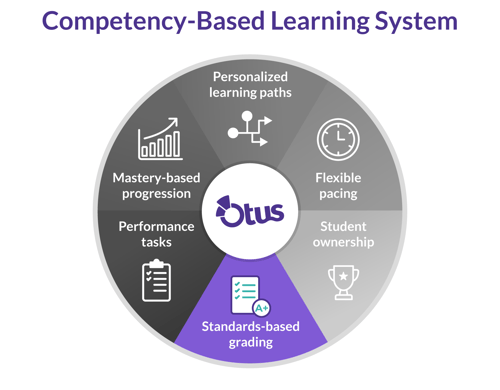
A helpful way to picture it: SBG is often one important part of a competency-based system, but it is not the whole system.
A school can use standards-based grading without fully embracing competency-based learning. In fact, many do.
For example, a middle school might report student progress by standard, use a four-point proficiency scale, and separate academic performance from behavior. That is standards-based grading. But if students still move unit to unit on a fixed calendar regardless of mastery, the school is not really operating as competency-based.
|
Standards-Based Grading (SBG) |
Competency-Based Learning (CBL) |
|
Focuses on how student learning is graded and reported |
Focuses on how student learning is structured and progresses |
|
Measures performance against academic standards |
Measures mastery of competencies, which may include standards plus durable skills |
|
Helps teachers communicate strengths and needs more clearly |
Helps schools rethink pacing, progression, and evidence of learning |
|
Often used within a traditional school calendar and pacing model |
Often allows for flexible pacing based on mastery |
|
Primarily centered on grading practices |
Encompasses instruction, assessment, feedback, pacing, and reporting |
|
Can exist on its own |
Often includes a standards-based or mastery-aligned grading element |
Where standards-based grading and competency-based learning overlap
Even though they are different, SBG and CBL share a lot of DNA.
Both approaches:
- Move attention away from collecting points and toward demonstrating learning
- Make it harder for a grade to hide what’s actually going on
- Encourage clearer learning targets
- Absolutely depend on meaningful feedback
- Can support more equitable conversations about student progress
- Need to be implemented thoughtfully; neither is easy nor overnight
In a traditional system, a student might earn a B because they participate often, turn everything in, and do well enough on most assignments. That grade looks solid. But it does not reveal much. Is the student writing strong arguments? Citing evidence well? Organizing ideas clearly. It’s hard to tell.
In a standards-based grading system, their teacher can show that they are proficient in these areas.
In a competency-based environment, the school might take that a step further. The student may continue revising their writing until they demonstrate mastery of the writing competency, perhaps with support, reflection, and multiple forms of evidence along the way.
Same student and same general belief that learning matters more than points. Different level of system redesign.
What are schools using right now?
While there isn’t conclusive data on the matter, it’s safe to say more schools are using standards-based grading than fully implemented competency-based learning models. And that makes sense. SBG is often a more practical starting point.
SBG allows schools to improve grading and reporting without redesigning every part of instruction, scheduling, pacing, and student progression all at once. For most districts, that’s a big enough lift on its own.
A district might begin its journey toward SBG by separating academic achievement from behaviors, aligning grades to standards, creating common proficiency scales, and building more consistent report cards. That work alone can lead to stronger family communication, more focused intervention, and better conversations in PLCs.
Competency-based learning, on the other hand, usually asks for deeper systems change, if not a complete overhaul. It can touch everything from transcript design to scheduling to how teachers collaborate across courses and grade levels. Schools pursuing it are likely aiming for a broader vision of student success, one that includes academic mastery alongside habits of success, real-world application, and transferable skills. It’s more of the “complete package,” if you will.
What is competency-based assessment?
This is another term that tends to show up in the conversation.
Competency-based assessment refers to the ways students demonstrate mastery of a competency.
That evidence can take many forms. A quiz might be one option, but it is rarely the only one. Projects, performance tasks, presentations, portfolios, observations, and written reflections can all play a role, depending on the competency being measured.
For example, if the competency is “construct and defend an evidence-based argument,” a multiple-choice quiz may tell you a little. A written argument or classroom debate tells you much more. This isn’t to say a competency-based assessment is always flashy or elaborate, but rather that the evidence should match the learning goal.
That principle matters in standards-based grading, too. If schools want clear reporting on standards, they need assessments that pinpoint where students are in relation to those standards.
How can SBG and CBL work together?
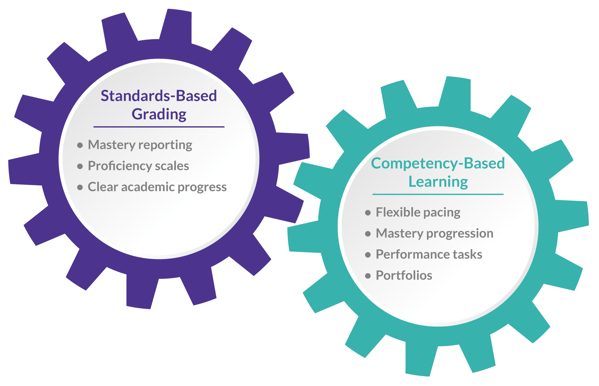 Very well, in fact, but only when schools are clear on the role each plays.
Standards-based grading can give schools the clear academic picture they need. It helps teachers, students, and families see learning progress in a more honest, detailed way. Competency-based learning can build on that foundation, creating the conditions for students to keep learning until they demonstrate mastery and, in some cases, to apply that learning in richer and more flexible ways.
If SBG sharpens the lens, CBL can change what the whole camera is pointed at.
A district might start with standards-based grading in elementary and middle school, then gradually build toward a competency-based structure in high school, where portfolios, performance-based tasks, and graduate profile competencies become a bigger part of the student experience.
Or a district may stay rooted in SBG while borrowing some competency-based ideas, like reassessment opportunities, clearer mastery criteria, or more student ownership of evidence.
Schools don’t have to choose one or the other. A better approach is to ask: What problem are we trying to solve? If the biggest issue is unclear grades, standards-based grading may be the right place to begin. If the issue is that time-based progression keeps moving students along before learning is solidified, competency-based learning may need to be a part of the conversation, too.
Why this matters for teachers, students, and families
This is not just a terminology debate. When SBG and CBL get lumped together, schools can end up with muddled conversations and a messy implementation. These models ask schools to solve different problems, and when that distinction is not clear, planning, communication, and follow-through all get harder.
Getting clear on the difference helps everyone. It gives teachers more focused explanations, helps leaders plan professional learning more intentionally, and makes student progress easier for families to understand. Most importantly, it can make school feel less like a guessing game for students.
That clarity matters to everyone involved.
Where Otus fits in
Whether a school is implementing standards-based grading, exploring competency-based learning, or trying to make sense of both, one thing becomes obvious pretty quickly: you need a clear way to see student learning.
That means more than a gradebook. Schools need a way to connect standards, assessments, reporting, and student data so educators aren’t piecing together the full story from different tools and sources.
For schools focused on standards-based grading, that may mean making sure assessments are aligned to standards and that report cards give families a clearer picture of student progress. For schools moving toward competency-based learning, it may also mean gathering evidence in different ways and tracking growth over time so it’s easier to see when students are truly ready to move forward.
And that kind of work gets much easier when the system supporting it is connected.
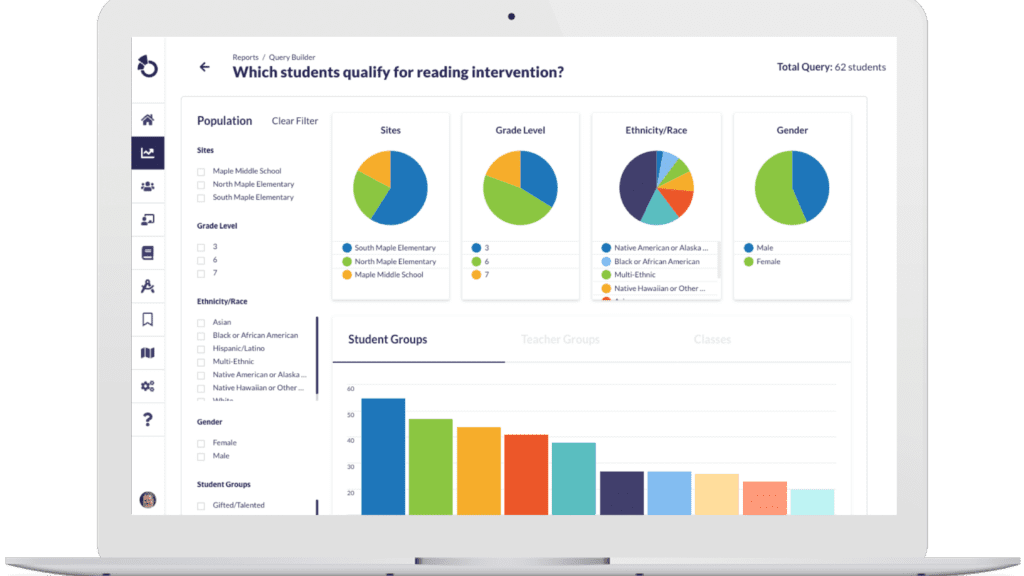
With Otus, schools can bring grading, assessment, and student performance data into one place. Educators can see how students are progressing on specific standards, build and analyze assessments, and use that information to support instruction, intervention, and team conversations. Instead of spending time hunting for the right spreadsheet or report, teams can spend more time responding to what the data is showing.
Frequently Asked Questions
If a district is interested in both SBG and CBL, where should they start?
In many cases, the best starting point is not with the report card itself. It’s with shared clarity. Districts need to agree on what they want grades to mean, what mastery looks like, and what problem they are trying to solve. From there, many schools begin with standards-based grading because it creates a clearer foundation for assessment, reporting, and instructional conversations. Once that foundation is in place, schools may be in a better position to decide whether they also want to move toward broader competency-based structures around pacing, credit, student agency, and demonstrations of learning.
How do implementation timelines usually differ for SBG and CBL?
In most districts, standards-based grading can be implemented more quickly than competency-based learning because the scope is narrower. SBG usually focuses on grading and reporting practices, which may involve revising proficiency scales, aligning assessments to standards, updating report cards, and helping teachers build shared expectations around evidence of learning. For some schools, that work may begin to take shape within a year.
Competency-based learning usually takes more time because it asks schools to rethink much more than grading. In addition to defining competencies, districts may need to revisit pacing, credit models, assessment design, student agency, and how mastery is communicated across classrooms and grade levels. And that’s no small feat. In many cases, that kind of shift unfolds over several years rather than a single school year.
Are competencies and standards the same thing?
Sometimes they overlap, but they are not always identical. A standard is usually a specific academic expectation tied to a subject or grade level. A competency is often broader and may combine knowledge, skills, and application. In some systems, competencies are built directly from academic standards. In others, they also include habits of success or durable skills such as collaboration, communication, or problem-solving.
That is precisely why competency-based learning often feels bigger than standards-based grading. It usually asks schools to define success more broadly than just academic content.
How do assessment practices differ in SBG and CBL?
Both SBG and CBL depend on clear evidence of learning, but they do not always use that evidence in the same way. In standards-based grading, assessments are typically used to measure a student’s current level of performance on specific academic standards. The goal is to report progress clearly and accurately, often within a more traditional course structure.
In competency-based learning, assessment plays a broader role. It’s not just about reporting where a student is. It also helps determine when a student is ready to move forward. That often means students demonstrate learning through a wider range of evidence, over a longer stretch of time, and sometimes in different contexts. In other words, SBG tends to sharpen how learning is measured, while CBL often changes what that evidence is used for.
How do pacing and progression differ in SBG and CBL?
This is one of the clearest differences between the two. In a standards-based grading system, students often move through a course on a fairly fixed timeline. The grading becomes more precise, but the pace of the class may stay mostly the same. A student might be marked as developing on a standard, but the class still moves on to the next unit.
In competency-based learning, pacing and progression are much more closely tied to mastery. Students are expected to move forward only when they have demonstrated readiness, not simply because the calendar says it is time. That doesn’t necessarily mean every student is working on something different every day, but it does mean the system is designed to be more responsive to where students are in their learning journey.
Why do schools struggle to explain these models to families?
Because families often hear familiar words in an unfamiliar way. A report card may still include scales, scores, or course names, but the meaning behind those marks has changed. If schools do not explain that shift clearly, families can end up trying to interpret a new system through an old lens.
This is especially true with standards-based grading. Parents may ask why homework doesn’t count the same way it used to, why retakes are allowed, or why one subject now shows multiple scores instead of one average. And those are fair questions. Schools need clear language and consistent communication if they want families to understand (and support) what the new system is trying to accomplish.
Related Resources
Request a demo!
See exactly how Otus can help your school accelerate student growth and improve student outcomes – all while saving educators time.