

Sep 7, 2026
Schools do not need AI to make mastery learning work.
Standards-based grading (SBG) and competency-based learning (CBL) already offer a stronger way to think about
progress, feedback, and evidence of learning. What AI can do is help schools carry that work with more clarity and less friction.
Both SBG and CBL offer a richer picture of student learning than traditional grading systems usually do. Instead of one course average, educators may be working with standards-aligned assessment data, rubric scores, progress over time, reassessment evidence, and signs that a student is either ready to move forward or needs more support. That’s incredibly useful, but it’s also a lot to interpret.
This is where AI starts to earn its place in the conversation.
Used well, AI can help educators spend less time sorting through information and more time deciding how to respond to what students are showing. Used poorly, it can create more noise and more distance from the real work of teaching and learning.
There’s no question that AI belongs in the conversation around SBG and CBL. But it’s crucial that schools understand how to use it in ways that truly strengthen their understanding and use of mastery.
How AI can support standards-based grading
Standards-based grading really shines when schools can clearly see how students are performing against specific skills and standards. AI can help by making that information easier to interpret and act on.
A teacher might use AI to identify patterns across standards and notice that a student is doing well on procedural work but still struggling to explain their reasoning. It can also help PLCs spot when one standard is producing uneven results across classrooms or help school leaders see which standards are causing the most difficulty across a grade level without digging through multiple reports by hand.
Now is a good time to clarify: AI should not be assigning mastery or replacing teacher judgment. Its value is in helping schools get more out of standards-based evidence that already exists.
That’s one of the strongest use cases here. Standards-based grading can generate a much clearer picture of learning, but only if educators have the time and tools to work with that picture. AI can help shorten the distance between seeing the data and doing something with it.
Say, for example, a middle school math team is reviewing performance across several standards. On the surface, one student seems to be doing fine. Their overall progress looks steady enough. But once the team uses AI to look more closely at the evidence, a more useful pattern comes into view: the student is consistently successful when solving equations in familiar formats, but starts to wobble when the same skill shows up in multi-step word problems. That gives teachers something much more specific to respond to than a broad sense that the student is “mostly okay” in math.
Visibility like that can significantly sharpen instruction. It also strengthens intervention decisions and even makes conversations with families more concrete.
How AI can enhance competency-based learning
 Competency-based learning raises the complexity a bit. If students are progressing based on demonstrated mastery, schools need a reliable way to see that mastery across time, tasks, and contexts.
AI can help educators work with a wider range of evidence without losing the thread. It can bring performance patterns into focus and help show whether a student seems ready for what comes next or still needs more time and support. That can be especially useful when mastery is being demonstrated through more than one type of assessment.
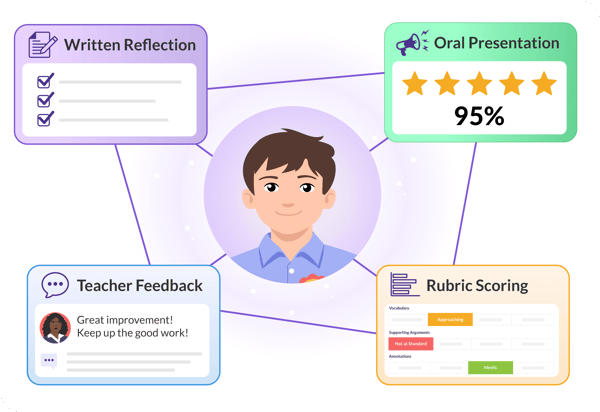
Take a high school student working toward a communication competency. Their evidence may include a presentation, written reflection, teacher feedback, and rubric-based scoring collected over the course of several weeks. Each piece says something helpful, but none tells the entire story on its own. AI can help bring those signals together and highlight patterns that support stronger teacher decision-making.
And that other student who sounds confident during presentations but struggles to organize ideas clearly in writing? That’s exactly the kind of pattern AI can help surface faster. AI should not decide whether mastery has been met. It can, however, help a teacher see the broader arc of growth more quickly and respond more thoughtfully.
This is one of the reasons AI competency-based learning conversations are springing up. CBL asks schools to work with more flexible pacing, more varied evidence, and a more nuanced understanding of student readiness. AI makes that work more manageable, especially when the alternative is sorting through it all by hand.
How AI can help bridge SBG and CBL
SBG and CBL are often discussed separately (or confused with one another), but in practice, they overlap quite a bit. One helps schools communicate learning more clearly. The other builds a model around mastery, progression, and application. AI can help connect the evidence behind both.
A school may be using standards-based grading to build a clearer academic picture while also moving toward broader competency-based structures that include durable skills, performance tasks, or Portrait of a Graduate work. AI can help educators connect those signals instead of treating them as separate stories.
Say a student looks strong on individual standards but still struggles when asked to apply those skills in a more open-ended competency-based task (think an oral presentation). Those are precisely the kinds of nuances teachers are looking for, but they’re not always easy to spot.
AI can help connect academic performance, broader evidence, and trends over time in a way that gives educators a stronger starting point.
Where AI can go wrong
This is where schools need to stay grounded.
AI cannot fix unclear standards or weak assessments. And it certainly won’t realign inconsistent grading practices. Put simply, if the foundation is shaky, AI will not solve the problem. If anything, it may just process the confusion faster.
It’s also a mistake to treat AI-generated insights as automatically objective. They still need human review, context, and professional judgment. When schools start leaning on AI to make high-stakes decisions about mastery, progression, or intervention without enough educator oversight, they are handing off too much.
Another common mistake is layering AI on top of too many disconnected systems and expecting clarity to somehow emerge. If grading, assessment, reporting, and progress monitoring are all fragmented, AI may help summarize what’s there, but it can’t magically create coherence where none exists.
At the end of the day, the strongest use of AI in this space is thoughtful support for educators who are already doing the hard work of defining mastery, collecting evidence, and responding to what students are showing.
What this looks like in the classroom
A sixth-grade science team may feel like students are doing reasonably well overall, but AI-supported analysis might reveal a recurring pattern: many can identify scientific concepts correctly, yet struggle to explain their reasoning with evidence. That gives the team something much more useful to respond to than a general sense that students are “fine.”
The same goes for district leaders. If a leadership team is trying to understand whether grading reform is leading to better visibility, not just different report cards, AI can help spot trends across standards, flag where support is needed most, and surface whether certain competencies are consistently harder for students to demonstrate. That gives leaders something more useful than a vague feeling that the work is or is not paying off.
The long and the short of it? AI is most helpful when it connects the dots faster while still leaving judgment in educators’ hands.
How Otus AI supports SBG and CBL
For schools using standards-based grading or competency-based learning, clarity is key. Otus helps support that work by connecting grading and reporting, standards-aligned assessments, and data and analytics in one place.
With AI-powered insights built right into the platform, educators can spot patterns faster, track progress against standards more clearly, and bring stronger evidence into conversations about instruction, intervention, and support. Just as important, schools gain a partner that can help make this work more consistent and sustainable over time. That kind of connected visibility makes mastery more understandable and actionable.
Request a demo!
See exactly how Otus can help your school accelerate student growth and improve student outcomes – all while saving educators time.