

Aug 6, 2026
Think back to your own experience with grades. If you worked hard, turned in your assignments, and did reasonably well on tests, you probably earned solid marks — and that felt fair. But what if there was one concept you never quite grasped? Would anyone have caught it? Would you have known, before it quietly became a gap that made the following unit or school year harder?
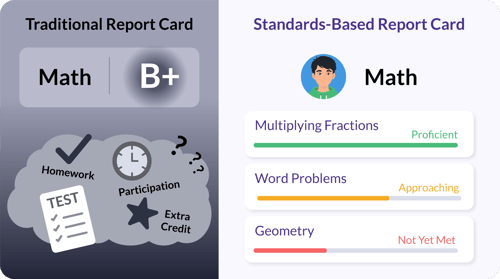 That's the problem traditional letter grades were never designed to solve. An A, B, C, D, or F tells you the outcome, not the story behind it.
That’s why a growing number of schools, particularly at the elementary and middle school level, are making the shift to Standards-Based Grading (SBG). Rather than combining effort, behavior, homework completion, and test scores into a single letter, SBG reports on each skill separately — showing exactly what a student has mastered and where they still need support.
Grading should be one of the most useful tools in a school's MTSS toolkit. Too often, traditional grading causes confusion instead. SBG changes that — giving teachers, families, and students a clearer, more honest picture of learning, making every MTSS decision faster and more effective.
Is Standards-Based Grading the Best Fit for MTSS Success?
At its core, Multi-Tiered System of Supports (MTSS) is a framework that helps schools get the right support to the right students at the right time. Traditional grading blends many things that MTSS needs to keep separate. When a report card grade bundles together homework completion, classroom behavior, participation, extra credit, late penalties, and academic mastery, it becomes impossible to answer the central MTSS question: What does this student know, and where are any gaps?
With traditional grading, a dutiful student can earn a B while missing critical foundational skills, and a capable but disorganized student can earn a D that triggers unnecessary concern focused on the wrong area for improvement. These traditional grades can mask which students require more targeted support and can ultimately be unreliable for MTSS decisions
Instead of mixing together test scores, homework completion, participation, extra credit, and behavior, SBG removes all of the non-academic influence on grades, and the proficiency scale utilized in SBG shows how well a student is performing on the skills and standards they are expected to learn in real time. This is why SBG is in perfect alignment with and helps districts meet their MTSS goals.
How SBG Supports Each Tier of MTSS
Standards-based grading aligns naturally with each tier of MTSS, providing the precise, actionable information that each tier requires.
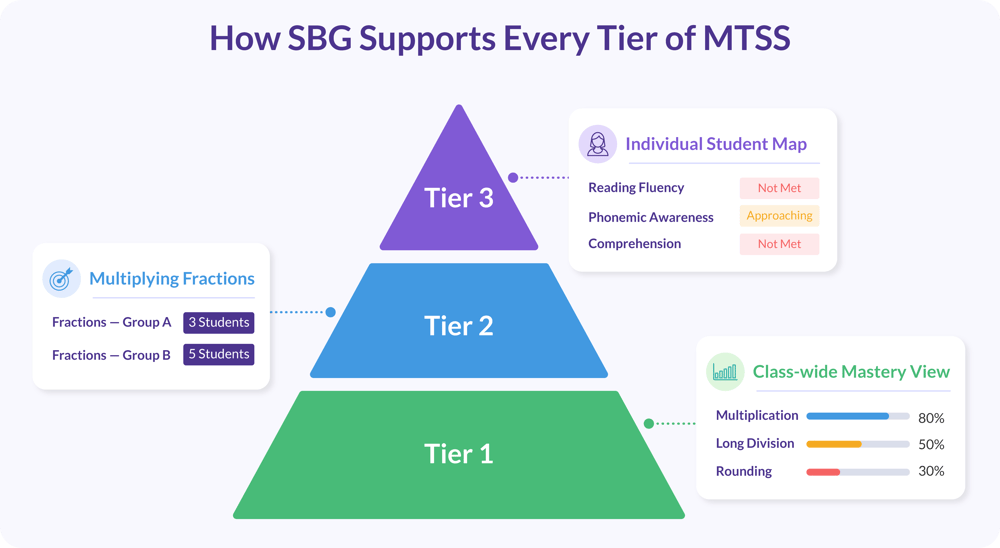
Tier 1: SBG Strengthens Core Instruction
The most powerful thing SBG does for Tier 1 instruction is give teachers a real-time view of class- and grade-wide mastery. When a teacher can see that a large percentage of students are below proficiency on a specific standard, they can reteach, restructure, and redesign core instruction before those students ever fall far enough behind to need a Tier 2 referral.
Tier 2: SBG Guides Precise, Targeted Intervention
Tier 2 intervention works best when it is closely aligned to a specific skill gap. SBG enables exactly that. Instead of placing a student in a general "reading group," a teacher armed with SBG data can identify which specific skills each student is struggling with, group those students together, and effectively match that group to an intervention that targets that specific skill.
Tier 3: SBG Pinpoints Intensive, Individualized Instruction
At Tier 3, students often have a variety of needs. Traditional grades provide no roadmap for this — a D or an F tells a specialist very little about where to get started with an intervention. SBG provides a detailed map of which standards have been mastered and which remain elusive. This map becomes the foundation for an individualized education plan (IEP) and ultimately may lead to a Special Education referral.
From whole-class instruction to individualized plans, SBG provides every educator at every tier the exact data they need to make smarter, faster decisions for students. A student’s work ethic cannot hide their learning gaps. By separating the two, the students who need support actually get it, and no one slips through the cracks.
|
MTSS Instruction |
Standards-Based Grading |
|
Tier 1 provides high-quality, standards-aligned instruction for all students. |
SBG reveals standards the whole class or grade is struggling with — enabling universal adjustments before students ever need intervention. |
|
Tier 2 offers targeted, small-group interventions for students not meeting expected progress. |
SBG shows exactly which standards each student hasn't mastered, enabling small group intervention to be precise and skills-focused. |
|
Tier 3 delivers intensive, individualized instruction for a smaller group of students with persistent academic needs. |
SBG provides the detailed data needed to build individualized plans, track progress on specific skills, and adjust intervention intensity accordingly. |
Better Data, Better Decisions: SBG and Progress Monitoring
At the heart of both Standards-Based Grading and MTSS progress monitoring is the same fundamental question: Is this student growing on this specific skill — and is our support working?
Traditional grades can't reliably answer that. A semester average looks the same in October as it does in May, even if a student has made significant gains. A student who struggled early but responded well to intervention can still carry a low grade because those early scores are permanently baked into the math. The grade doesn't tell you where the student is — it tells you where they've been.
SBG works differently. Rather than averaging all scores together, SBG reflects the most recent, consistent evidence of what a student knows. When a student demonstrates mastery of a skill they previously struggled with, that growth shows up immediately — not buried under earlier data points. This is exactly the logic that drives MTSS progress monitoring: measure the skill regularly and let the most current evidence guide the next decision.
That shared philosophy is what makes SBG and progress monitoring such natural partners. When a student is receiving Tier 2 or Tier 3 intervention, SBG is a living document of growth on the specific standards being targeted. Teachers and specialists can track whether intervention gains are sticking and transferring into real classroom mastery, not just performance on a standalone assessment.
When grading and MTSS are truly aligned — transparent, skill-specific, and free of non-academic factors — the data flowing into intervention decisions is clean, current, and actionable. That's when both systems work the way they were designed to.
Best Practices for Aligning SBG and MTSS
Adopting Standards-Based Grading is a significant shift — one that challenges assumptions about grading that have been in place for generations. Done well, it makes MTSS faster, more equitable, and more impactful.
- Designate priority standards. You can't measure everything at once, and you shouldn't try to. Before the year begins, identify the standards that matter most for grade-level success and make sure every teacher, interventionist, and specialist is working from the same list. When everyone is working from the same list, MTSS conversations become faster, and referral decisions become simpler.
- Set clear thresholds for tier movement. Decide in advance what SBG evidence triggers a Tier 2 or Tier 3 review as well as what evidence triggers an exit from intervention. When the criteria are defined before the school year starts, placement decisions are consistent, defensible, and fair for every student.
- Time assessments around data meetings. Intervention cycles can be fast, and having timely, accurate data is crucial. Update standards-based grades on the priority standards before each MTSS data meeting so decisions are based on current information.
- Use class-wide SBG data to strengthen Tier 1. If a majority of students are below proficiency on a standard, reteach it to everyone — this is one of the best features of SBG. It provides insight to when core instruction needs adjustment, as opposed to individual interventions. Intervention should be the exception, not the default.
- Explain the transition to SBG to families. One thing almost all parents have in common is that they have all received grades when they were in school, and they were likely traditional grades. A family who understands what "approaching proficiency" actually means is far more likely to support the process, follow through at home, and trust the school when intervention is recommended.
The bottom line: SBG and MTSS don't align automatically. That alignment has to be intentionally built, clearly communicated, and consistently confirmed. When it is, both systems deliver on their promise — and every student is better for it.
SBG: Grading with a Purpose
Grades should do more than mark the end of a unit; they should drive what happens next. When grading is done well, it tells teachers where to adjust instruction, tells families where their child stands, and tells students what they still need to learn. SBG gets grading back to that core purpose: honest, specific, and actionable information that moves learning forward for every student. That's what makes it such a natural fit for MTSS — and why schools that align the two don't just see better data. They see better outcomes.
Request a demo!
See exactly how Otus can help your school accelerate student growth and improve student outcomes – all while saving educators time.