

Jun 1, 2026
Standards-based grading tends to bring out… strong opinions.
For some educators, it feels like a long-overdue shift toward clearer, more honest communication about student learning. For others, it raises a whole list of concerns.
Will this confuse families?
Lower expectations?
Create more work for teachers?
Make it harder for students applying to colleges?
And those questions didn’t appear out of thin air. In plenty of schools, standards-based grading has been rolled out unevenly, explained vaguely, or reduced to a surface-level report card change without doing the necessary work to make it truly impactful. Unfortunately, that is exactly the kind of environment where myths take root.
A parent sees a new grading scale and assumes expectations have dropped (or worse, they don’t even understand what they’re looking at). A teacher hears that homework will not count the same way and worries that accountability is disappearing. A district team starts using the language of mastery, but not everyone means the same thing when they say it. Before long, people are reacting to a half-explained version of standards-based grading instead of the real thing.
That is why this topic gets so tangled. Some criticisms of standards-based grading are really critiques of poor communication or shaky rollout. Others come from long-held assumptions of what grades are supposed to look like and do. Either way, the result is the same: a lot of confusion and frustration around a model that is meant to make learning clearer, not murkier.
So, let’s sort through some of the biggest myths, look at where they come from, unpack what is actually true, and talk about how schools can keep them from taking hold.
What is standards-based grading, really?
Before we get into the myths, it helps to get clear on what standards-based grading actually is.
At a basic level, standards-based grading (commonly referred to as SBG) is an approach that measures student learning against specific standards rather than rolling everything into one overall average. Instead of mixing together test scores, homework completion, participation, extra credit, and behavior, SBG aims to show how well a student is performing on the skills and standards they are expected to learn. In other words, their grades reflect what they know and can do.
That sounds simple enough on paper. In practice, it can be a real shift.
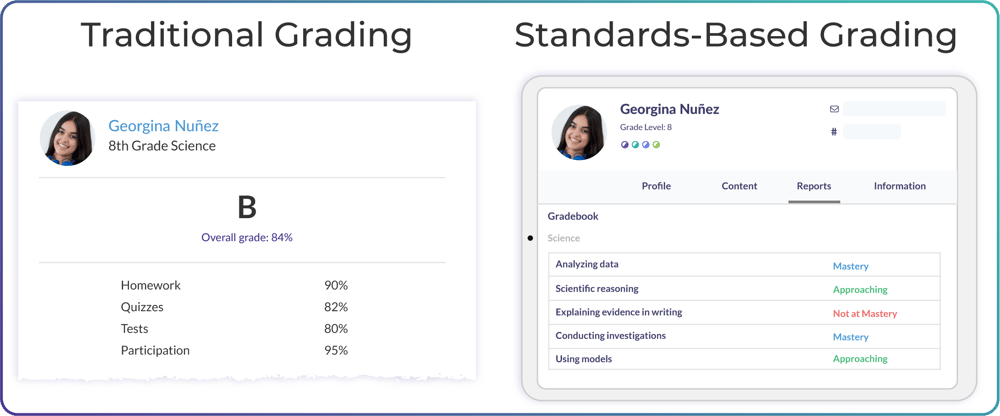
In a traditional system, a student in science class might turn in homework on time, do fairly well on quizzes and tests, and ultimately earn a B and leave it at that. In a standards-based system, that same student’s progress may be broken out more clearly. Maybe they are strong in analyzing data, still developing in scientific reasoning, and a little inconsistent when it comes to explaining evidence in writing. That paints a much more useful picture for teachers, families, and the student, too.
Of course, the clearer picture only helps if people understand what they are looking at. And that’s part of why so many myths about SBG stick around. When expectations are fuzzy, scales and language are inconsistent, or communication is thin, people fill in the gaps with their own assumptions.
That is where things can go sideways.
Myth 1: Standards-based grading lowers expectations
This is one of the most common criticisms of standards-based grading, and it’s not hard to see how it starts.
A district rolls out a new grading scale—fantastic. Teachers begin talking about something new to their school: reassessment. Homework counts differently than it used to, or in some cases, does not count toward the academic grade at all. A parent logs into the portal, sees fewer percentages and more proficiency levels, and starts wondering if the bar has been lowered.
From the outside, it can certainly look that way.
If people are used to equating rigor with points, penalties, and averaging, standards-based grading can feel softer at first glance. When a student no longer gets buried by one missing assignment or is offered a reassessment opportunity for a test they failed, it’s easy for someone to look at that and think, So… are we just making things easier now?
And that is where the myth takes hold.
But standards-based grading isn’t intended to lower expectations. If anything, it raises the pressure on schools to be much clearer about what students are expected to learn and what mastery of a skill or subject really looks like.
In a traditional system, a student can sometimes do just enough to survive the gradebook without ever showing a strong command of the most important skills. They might earn points for participation, completion, or lower-stakes assignments (they may even bring in a tissue box to net a few points). The final grade can look respectable even when the learning picture underneath it is pretty distorted.
Standards-based grading shines a brighter light on that.
In a tenth-grade English class that’s using a traditional model, a student might earn a B because they turn everything in, stay engaged in class, and do fairly well on most assignments. All well and good, right? But under standards-based grading, that same student’s performance may tell a more interesting story: strong in class discussion, still developing in citing textual evidence, and not yet consistent in written analysis. Suddenly, the conversation is not, “How did they get an 84?” It’s “Can they actually do the work this course is asking of them?”
If anything, that is a clearer expectation, not a lower one.
This myth also tends to pop up when schools confuse accountability with academic accuracy. Deadlines, effort, responsibility, and follow-through matter. Of course they do. But when those things are blended into a grade, it becomes harder to tell whether the grade is reporting learning, behavior, or some mix of both. Standards-based grading asks schools to get more honest about that distinction.
And that honesty can feel tough at first. Because once the standard is visible, the gaps are, too.
A stronger grading system does not let students hide behind charm, compliance, or point-chasing. It asks a more direct question: What has this student actually demonstrated? That is the real shift. One toward higher clarity.
Myth 2: Standards-based grading inflates grades
This one tends to show up right from the get-go, right as school communities begin to see changes that look very different from traditional grading.
Zeroes may carry less weight. Reassessments may become more common. Homework may no longer count the same way. A report card suddenly shows proficiency levels instead of the familiar percentages. And almost immediately, someone asks the big question: Are we inflating grades?
It’s a fair question, and it comes from a good place. But it usually points to a deeper misunderstanding of what standards-based grading is trying to measure.
As we covered earlier, traditional grades often reflect a mix of academic performance, work habits, timeliness, and so on. That can make a grade feel objective and all-encompassing, especially when it ends in a clean percentage like 75 or 93. But that number can hide a lot.
 A student who understands the content may earn a lower grade because of missing assignments or late work. Another student may earn a higher grade by completing everything and collecting points, even if their understanding is shaky in key areas. The grades look precise, but they aren’t always accurate.
That’s where standards-based grading changes the picture.
SBG isn’t meant to artificially boost scores, but rather to report learning more honestly. When a grade is tied more directly to standards, the question becomes narrower and more useful: How well has the student demonstrated this skill?
That shift can absolutely change the final mark. But a different result isn’t the same thing as an inflated one.
Say, for example, there are two students in an eighth-grade science class. One turns in every assignment, keeps a neat notebook, and always does the extra credit. The other is less consistent with homework but can clearly explain the phases of the moon, interpret a data table, and apply the concept correctly during an assessment. In a traditional gradebook, the first student would likely come out ahead because the system rewards completion. In a standards-based gradebook, the second student would likely show stronger mastery of the actual standards. The actual learning.
That can look suspicious if you’re used to the old system. But what is really happening is that the grade is telling a different story. Likely, a more accurate one.
This myth can also grow when schools make policy changes without explaining the purpose behind them. If families hear, “We are reducing the impact of zeroes,” without hearing the larger rationale, they might assume expectations are slipping. Similarly, if teachers are told to allow reassessment but aren’t given clear guardrails, it can start to feel too loose. And if report cards change formats before the community understands what those new marks mean, skepticism fills the gap fast.
That’s far from grade inflation. That’s a communication problem, and a big one.
Of course, poor implementation makes this myth even louder. If proficiency scales are vague, if reassessment practices vary from one classroom to another, or if the evidence going into the grade is not well aligned, people may start questioning the results. And honestly, they should. But that is not proof that standards-based grading inflates grades. It is, however, a sign that the system needs more clarity and consistency.
At its best, SBG does not make grades higher. It makes them cleaner by stripping away some of the noise that can distort the picture, and it asks schools to report student learning with more precision and less guesswork.
That can be uncomfortable, especially when people have long associated harsh grading with high standards. But harsher is not the same as more accurate.
Myth 3: Standards-based grading is confusing for families
This myth sticks around because, in a lot of schools, it feels (and might even be) true at first.
A family opens the grade portal and sees a 3 instead of an 87. Or maybe they see several 3s under one subject instead of one overall average. The report reads developing, proficient, or advanced, but no one ever really explained what these terms mean in practice. What they mean for their child. At parent-teacher conferences, one teacher describes the scale one way, another explains it differently, and now the family is left trying to make sense of a system that feels unfamiliar and inconsistent.
That is truly frustrating. And it’s usually when people start saying standards-based grading is too confusing.
In a traditional system, families may not always get a very detailed picture of learning, but they at least know how to interpret the symbols. They scored 93% on a math test when they were in school. They passed science class with a B+. Parents know what these grades mean, even if they don’t tell them much about specific strengths or struggles.
Standards-based grading asks parents to read progress differently.
Instead of asking, “What’s my child’s average in math?” families may be looking at a breakdown that shows their child is meeting expectations and solving equations, but still developing in interpreting graphs. Instead of seeing an English grade, they may see separate indicators for reading comprehension, written analysis, and speaking skills. More useful? Most certainly. But only if families know what they are looking at.
If a parent logs into the portal after the first grading period and sees that their daughter has a 2 in one reading standard, a 3 in another, and no overall percentage for the class—and nobody has walked them through what the scales mean—their first reaction won’t be, “Wow, look at this wealth of information!” It will be, “Wait… is she behind?”
That reaction makes sense.
This is one of the biggest reasons for misunderstandings about SBG. Families are often hearing familiar words in an unfamiliar way. Grade, progress, proficient, mastery. Those words may sound straightforward, but they land differently when the system underneath them has changed.
And to be fair, schools sometimes make this harder than it needs to be. If the rollout focuses too heavily on the report card format and brushes over the deeper why, families are left trying to decode a new system on their own. If teachers aren’t using shared language, families hear one explanation for their fourth grader and a different explanation for their sixth grader. If concrete, tangible examples are missing, the whole thing can feel abstract fast.
Of course, that doesn’t mean standards-based grading is inherently confusing. But it does mean that schools need to teach the system as clearly as they expect families to understand it.
Once that happens, it usually clears up the confusion. And the conversations become much more meaningful.
A family stops asking, “Why did my child get a 72?” and starts asking, “Which skills are going well, and where do they need more support?” A much more useful question. It opens the doors to a more specific conversation. It also gives families something a traditional average often cannot: a clearer window into what their child is learning.
So yes, standards-based grading can feel confusing to families at first. That part is real. But the confusion usually comes from unfamiliarity, inconsistency, or weak communication, not from the grading model itself. When schools explain the system well and back it up with clear examples, families are often able to make sense of it just fine. In many cases, they end up with a much better picture than they had before. And at the end of the day, that’s really the goal of standards-based grading.
Myth 4: Standards-based grading means behavior, effort, and deadlines no longer matter
As you might have guessed, this myth shows up the minute people hear that homework may not count the same way, late penalties may be handled differently, or academic grades may no longer include participation and effort.
 And it’s easy to see why it rattles people.
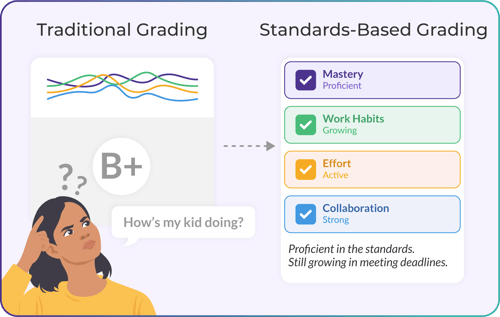
A teacher hears, “We are separating behavior from mastery,” and immediately thinks, So what happens when a student doesn’t turn things in? If a parent hears that responsibility will be reported separately, they might wonder if the school is sending a message that deadlines are optional. A PLC team shifting toward standards-based grading might stop and say, “Wait, are we saying work habits don’t matter anymore?”
No. Not at all.
Standards-based grading is not built on the idea that effort, responsibility, participation, and timeliness are unimportant. But a key feature of SBG is that these ideas are communicated honestly.
That is a big difference.
In a traditional system, those factors are almost always incorporated into one overall grade. A student who fully understands the material but misses a homework assignment may receive a lower grade, while a student who is organized and compliant can earn a higher grade despite struggling with the content. One way to look at it is that a single number (the overall grade) is doing too many jobs at once. It’s trying to communicate learning, behavior, habits, and sometimes even attitude.
Once again, the old way feels familiar, but it’s not always clear.
Standards-based grading pushes schools to separate those signals. The academic grade is meant to reflect learning against standards. Work habits, behavior, and responsibility can still be reported, discussed, and addressed, but they aren’t allowed to muddy the picture of academic mastery.
Say a middle school social studies teacher is reviewing two students. One participates actively, always brings the necessary materials, and turns everything in on time, but struggles to analyze primary sources. The other student is a bit messy and misses a couple of assignments, but when given the chance to demonstrate the standard, they absolutely nail it, showing strong historical reasoning and supporting their claims with evidence. In a traditional gradebook, the first student may look stronger overall. In a standards-based system, the conversation gets more precise. One student shows stronger work habits. The other shows stronger mastery of a standard. Both matter; they are just no longer hidden in the same score.
And that distinction can help schools respond more effectively.
If a student is struggling because they don’t understand the content they’re being taught, that calls for one kind of support. If a student understands everything but can’t seem to stay organized or meet deadlines, that calls for another kind of support. When everything gets blended into one grade, it’s much harder to tell which problem the school needs to focus on.
This is also where implementation matters a lot. If a school says behavior and effort will be separated but never creates a clear way to report those things, people may assume they have vanished. If teachers are all handling deadlines differently, families may feel like expectations are all over the place. And if students hear “homework doesn’t count” without understanding why it still matters for their success, the wrong message can spread fast.
That isn’t a flaw of standards-based grading. In fact, it’s a pitfall that can come with any major initiative when schools don’t have strong systems and clear communication.
Myth 5: Standards-based grading creates a “good enough” culture
 This myth usually surfaces when people worry students will treat proficiency as the endpoint rather than a point along the journey.
A teacher looks at their school’s new scale and worries that once a student hits proficient, they’ll have no reason to keep pushing. A parent hears that the goal is mastery and wonders whether that just means students will do the bare minimum required to check the box. A PLC team member wonders, Are we building a system where kids aim for a 3 and call it a day?
It’s a fair concern. No school wants to create a culture where students do the least they can get away with.
But that isn’t something that standards-based grading creates. If anything, that kind of mindset can show up under any grading model.
In a traditional system, students learn the game of school all the time. They figure out how many points they need, which assignments matter most, whether extra credit is available, and how much effort it will take to keep the average where they want it. And that’s not exactly a culture of deep learning. It’s just a more familiar version of the same behavior.
SBG didn’t invent minimum-seeking. Students have always been capable of asking, “What do I need to get by?” So, the question is, which of the two grading systems makes that behavior easier to hide and which makes it easier to address?
For a lot of schools, standards-based grading can make the conversation more honest.
If a high school algebra student is used to chasing points in a traditional system, they know that completing homework, picking up a few quiz points, and doing so-so on tests is enough to stay afloat with a C. They’ll likely never really confront which skills they have and have not mastered. Under standards-based grading, that same point-chasing student can see a much clearer picture: solving linear equations, yes; interpreting functions, not quite; applying algebraic reasoning in word problems, still a little shaky. Now the path forward is more visible. So is the gap.
That alone doesn’t automatically make a student want to push themselves further, of course. No grading model can do that by itself.
This is where classroom culture, task design, and school expectations come into play in a big way. If “proficient” is treated as the ceiling instead of a strong benchmark, students may absolutely stop there. If advanced performance is vague, inconsistent, or never really celebrated, there is less incentive to stretch. And if teachers are not given clear ways to define what deeper learning looks like, the whole thing can sort of just flatten.
It may seem like a standards-based grading flaw, but it’s really just an implementation challenge. The same kind of challenge that comes with any major initiative.
A strong SBG system should make room for high expectations, rich tasks, and continued growth after proficiency. It should help students see where they are, what quality looks like, what comes next; that’s really one of its biggest strengths. When the learning target is clear, students have a better shot at aiming higher than when they are just chasing points inside a gradebook.
So yes, some students may still look for the minimum. Students are students, after all. But that is absolutely not unique to SBG, and it is not proof that the model lowers ambition. More often, it’s a sign that schools need to be clearer about what proficiency means, what excellence means, and how both are communicated in daily practice.
Myth 6: Standards-based grading is too much work for teachers
This myth is sticky because, at least in one sense, it’s not entirely a myth.
For teachers, standards-based grading can feel overwhelming at first. It asks for new assessment design, stronger alignment to standards, more intentional feedback, and more shared understanding across teams. If school leaders move too quickly or skip the groundwork, SBG can feel like “just one more initiative” piled onto an already full plate.
That reaction is real.
If teachers are being asked to revise, rethink, and explain it all to families while still teaching five classes a day, someone is going to say, “This is too much.” And it doesn’t mean they’re rejecting standards-based grading. What they’re really reacting to is the very real weight of implementation.
That’s often how this myth takes shape. But it’s important to point out here that standards-based grading as a system is not too much work for teachers. It’s only when an initiative as ambitious as SBG is poorly planned that the work of teachers becomes nearly impossible.
When schools treat SBG like a quick policy shift, teachers often end up doing double the work. They are trying to translate old assignments into new scales, answer stakeholder questions on the fly, and build consistency at the same time. That is absolutely exhausting, and it can make the grading model itself take the blame.
But when schools do it well, the work looks totally different.
A great starting point is time. Time to clarify what each standard means. Time to look at student work together. Time to build shared expectations around proficiency. Time to decide what belongs in an academic grade and what should be reported separately. None of that is flashy, but it’s what makes the system usable instead of overwhelming.
There’s also a difference between more work and different work.
A traditional system can be incredibly time-consuming; ask any teacher. They may spend hours managing late work, calculating averages, ideating on extra credit opportunities (kids can only bring so many tissue boxes), fielding questions about points, and trying to explain why a student with an 89.4% didn’t get an A. That work is familiar, so it doesn’t always get framed as burdensome in the same way. But it’s still work.
SBG shifts some of that energy. Instead of spending so much time sorting and defending points, teachers may spend more time clarifying expectations, giving feedback tied to standards, and looking closely at evidence of learning. Arguably more meaningful work, but a real shift nonetheless. Early on, it can absolutely feel heavier. Over time, though, it can also lead to stronger consistency and richer conversations about student progress.
This is another area where systems can make or break a school's pursuit of SBG. If teachers are tracking standards in one place, storing evidence somewhere else, and piecing together the reporting side manually, SBG can quickly turn into a major headache. If the tools are clunky and the expectations vague, teacher frustration is inevitable.
But that’s not a problem inherent in SBG. It simply means implementation needs to respect teacher time.
Standards-based grading can (and likely should) require significant work, especially at the beginning. The real issue, however, is whether schools are building the conditions for teachers to do this well. Without time, clarity, support, and workable systems, almost any meaningful change will feel unsustainable.
Myth 7: Colleges don’t accept standards-based grading
Mention standards-based grading at the high school level, and this question is never far behind.
A parent hears that the district is moving toward standards-based grading and immediately jumps to the big one: What does this mean for college admissions? That reaction makes sense. Families want to know students will not be penalized later because their school chose a different way to communicate learning now.
But standards-based grading and college admissions are not at odds.
High schools across the country already use a wide range of grading systems, reporting practices, scales, and transcripts—some less common than SBG, even. Colleges are used to evaluating students from very different educational contexts. Districts don’t always define grades the same way, and colleges know this.
In some cases, schools using standards-based grading still translate student performance into a more traditional transcript format by the end of the semester or year. In others, schools provide additional context through school profiles, transcript notes, or other materials that explain how the grading system works. Colleges are not walking into this blind. If anything, it’s their job to understand students in context.
Now, that does not mean schools can be casual about it.
If a district is making a significant change to grading and reporting at the secondary level, it absolutely should think carefully about transcript design, communication with families, and how student performance will be represented beyond their classrooms. Leaders need to make sure the grading model is explained well and translated clearly where needed.
That may require a bit more work, but standards-based grading can also strengthen the story a school tells about student learning. It can offer a clearer picture of strengths, growth, and areas of mastery than a single, averaged grade ever could.
So no, colleges do not reject students because their school uses standards-based grading. But it is the school's responsibility to communicate its system clearly, both inside its community and beyond.
How Otus supports stronger standards-based grading implementation
If you’ve read this far, it’s safe to say you understand that standards-based grading works best when schools are clear on what they are measuring, consistent in how they report it, and ready to explain it to their school community. Otus supports that work by bringing grading and reporting, standards-aligned assessments, and data and analytics into one connected system.
Educators can track student performance against specific standards, families get a clearer picture of progress, and school teams have stronger evidence to guide instruction and support. That kind of visibility helps schools avoid the confusion and inconsistency that often fuels myths in the first place. And because implementation matters just as much as the tool itself, districts also gain a partner to help make the work more consistent and sustainable over time.
Request a demo!
See exactly how Otus can help your school accelerate student growth and improve student outcomes – all while saving educators time.