

Aug 13, 2026
It's no secret that educators need more than test scores to understand how a student is progressing, or how well a school is meeting its students' needs. That's been true for decades. The harder question to answer is what else should districts be measuring, tracking, and analyzing: Behavioral data? SEL information? Background information? Cognitive data?
The answer is all of it, connected through one complete student profile. Building a complete student profile is the key to understanding the whole child and driving real gains in engagement and achievement.
Why aren't test scores enough to understand a student?
Test scores tell educators what a student knows and doesn't know. They don't explain why a student hasn't mastered a skill, or what will help them master it. That's a narrow slice of insight when what educators actually need is depth.
A test score alone can't tell you:
- Why a student is struggling, whether it's a content mastery issue, a working memory challenge, a processing speed issue, or something else entirely
- How a student learns best, including their strengths, motivators, and preferred pace
- What to change instructionally so the next assessment looks different from the last one
- Whether the struggle is academic, behavioral, or rooted in something outside the classroom
Without that context, two students can end up with the same intervention plan for two completely different reasons, and neither one gets what they actually need. And that doesn’t help anyone.
What is needed if test scores aren’t enough?
Educators need to know how students learn, not just how they score. A complete student profile captures that:
|
Data/Insights |
Test Scores |
Student Profile |
|
Academic Skill Mastery |
✔️ |
✔️ |
|
Behavioral History |
✔️ |
|
|
Personal Interests |
|
✔️ |
|
Family and Demographic Information |
|
✔️ |
|
Cognitive Data |
|
✔️ |
When test scores are the only lens educators have, their approach is inevitably one-dimensional, because their data is. A complete student profile (behavior, personal context, learning style, academic performance) gives educators what they actually need to meet each student where they are.
What should districts measure in addition to test scores?
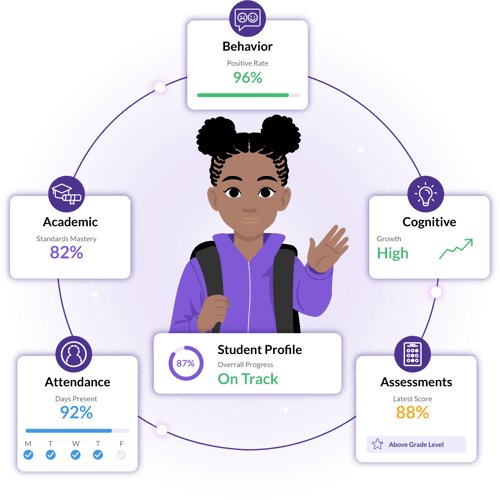 Building a complete profile requires two things: tools that capture richer data on each student, and a single system where educators and administrators can see it all together. Disconnected data creates an overwhelming, disorganized process. Connected data, paired with tools that translate it into instructional insight, is where the real change happens.
At a minimum, a complete student profile should include:
- Academic performance data, including standardized test scores and classroom assessments
- Behavioral history, from attendance patterns to discipline records
- Cognitive data, covering executive function, complex reasoning, memory, and processing speed
- SEL and background information, including personal interests and family context
- A single system to view it all, so educators aren't piecing insight together across five different logins
That last point matters as much as the data itself. A district can have every data point above and still fall short if the information lives in disconnected spreadsheets, platforms, and filing cabinets that no one has time to cross-reference.
How do cognitive assessments complement academic test scores?
Most schools haven't prioritized cognitive assessment beyond identifying students for gifted and talented programs. But understanding a student's cognitive strengths and challenges (the actual lens into how they learn) leads to meaningful shifts in instructional strategy, student grouping, and student agency.
Academic data shows what a student has learned. Cognitive data shows why a student may be struggling, so educators can adjust how they teach, how students engage with material, and how students ultimately break through to understand and master new skills.
Cognitive data typically covers a few core domains, each tied to specific classroom implications:
- Executive functions, which affect a student's ability to plan, organize, and manage multi-step tasks
- Complex reasoning, which shapes how well a student handles abstract or higher-order problem solving
- Memory, including how much information a student can hold and retrieve while learning something new
- Processing speed, which influences how quickly a student can work through material, and whether they need more time, not more content
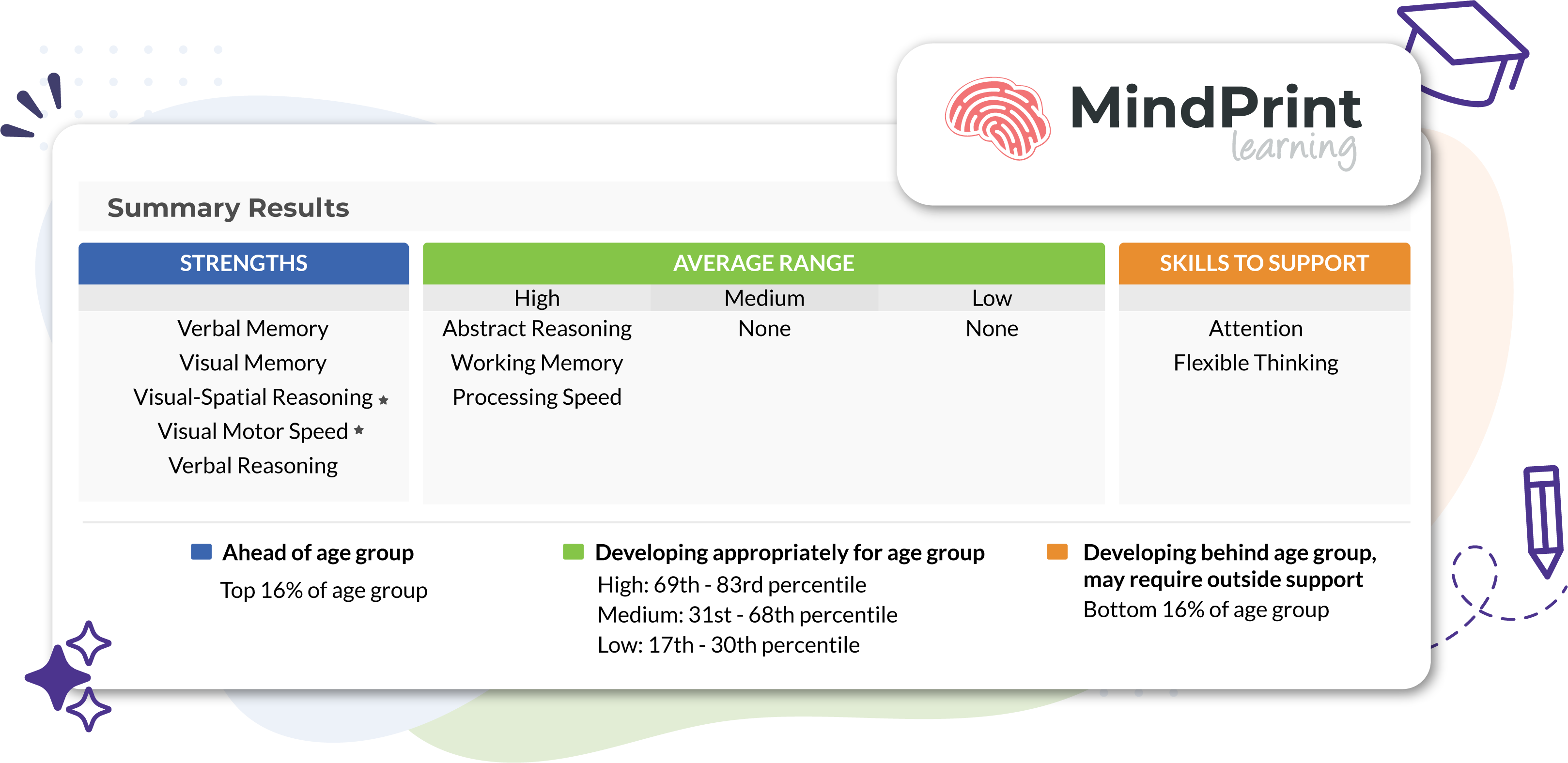
Knowing where a student falls in each of these areas gives educators a much more precise starting point than a test score alone. A student who struggles with processing speed needs a different response than one who struggles with memory, even if their academic scores look identical. Including cognitive data in a Student Profile ensures that educators can address the whole child.
What does data-driven decision-making look like beyond standardized testing?
With the full picture, educators can act before small challenges become large ones, i.e., before students disengage or behavior issues take over. That's data-driven decision-making that gets ahead of the problem instead of reacting to it.
In practice, this looks like:
- Grouping students by how they learn, not just by their most recent score
- Flagging early warning signs, like a drop in engagement, before it shows up as a failing grade
- Choosing interventions that match the root cause, instead of applying the same fix to every student who's struggling
- Giving students more agency by helping them understand their own strengths and learning style
None of this requires waiting for a crisis. It just requires having the right data on hand before the crisis starts.
Can two students with the same test score have different learning needs?
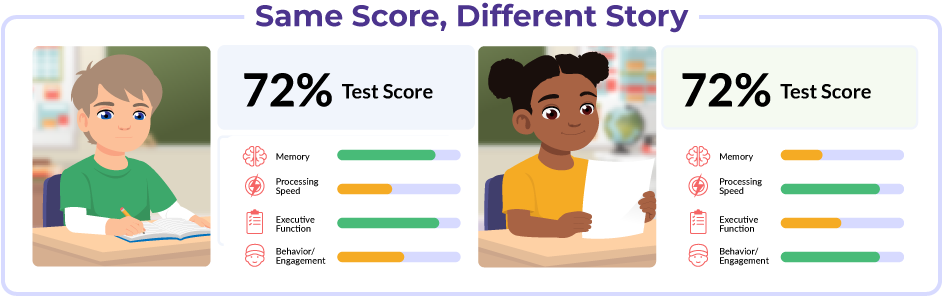
Absolutely. Two students can post identical test scores and need completely different instructional approaches. Academic data alone can't explain that gap — only more connected information can. Educators need the full picture to make instructional decisions that actually move the needle for each student. Where academic, behavioral, and cognitive data work together, not live in separate systems.
What tools are available to help schools understand students better?
Platforms like Otus bring together academic performance, behavior, and assessment results in one place. MindPrint adds the missing piece (the cognitive data that explains why a student is performing the way they are), so educators have whole-learner insights in one actionable Complete Student Profile. Together, MindPrint and Otus turn a stack of important, disconnected data points into one complete, actionable student profile.
Request a demo!
See exactly how Otus can help your school accelerate student growth and improve student outcomes – all while saving educators time.