

Sep 3, 2026
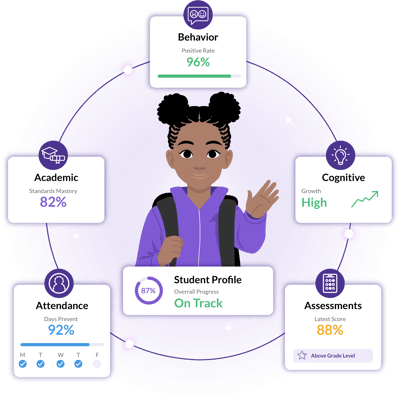 Capturing traditional grades, test scores, and data on academic performance is no longer enough to provide a high-quality education for students. A Complete Student Profile, one that brings a student's academic, behavioral, and cognitive data into one unified view, is the critical foundation for better student achievement and stronger student engagement. When that comprehensive profile of a student is centralized instead of scattered across a variety of systems, that's when the magic happens. When educators aren't piecing together grades, attendance, learning styles, plans, and portfolio work from separate places, they get something more valuable back: time and a clearer picture of the whole child.
The result: educators save time, and students get the support they actually need, when they need it.
What Information is Needed for a Complete Student Profile?
Many schools have learner profiles, but few have achieved a simple, accessible, complete one. For educators to get the most out of a Complete Student Profile, it needs to include the full picture of every student.
Here’s what districts need to build a student profile for personalized learning.
|
Information Type |
Benefit |
|
Academic Data |
Reveals where a student truly excels and where they need support, backed by real work samples |
|
Family, Community, Culture |
Helps educators understand the whole context a student comes from, building trust and making learning feel relevant and respectful of their background |
|
Behavioral History |
Surfaces patterns in attendance, communication, and social-emotional well-being early, so educators can step in before small issues become bigger barriers to learning |
|
Personal Interests |
Uncovers what actually motivates a student, making it easier to spark engagement and build a genuine connection to their learning |
|
Cognitive Data (Learning Style and Perferences) |
Shows how a student learns best, so teachers can tailor instruction in a way that finally clicks instead of a one-size-fits-all approach |
The last piece, cognitive data, is what many schools are missing, and it's the critical piece that makes a Complete Student Profile far more impactful than a traditional learner profile.
Why Cognitive Data Completes the Student Profile
Academic records tell you what a student can do. Cognitive data tells you why.
Take two students who both struggle with reading comprehension. On paper, they look the same. But one might have a processing speed challenge, while the other has a working memory gap. Same symptom, completely different root cause, and completely different interventions needed to address it.
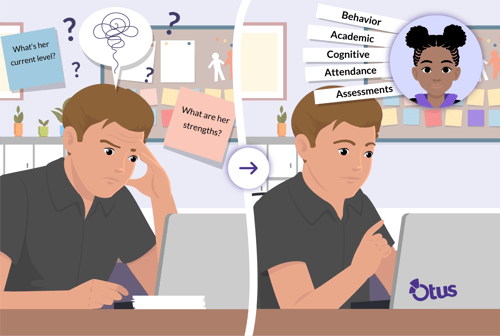 That's the gap cognitive data fills for educators. Having insights into a student's cognitive skills in a one-stop Complete Student Profile is a powerful tool for educators. Why?
Cognitive Data:
- Uncovers strengths academics can miss. A student with strong visual-spatial reasoning but weaker verbal skills might bomb a written test, then excel when given a hands-on or visual task. Without cognitive insight, that strength (and knowledge) never gets the chance to show up.
- Reframes behavior as communication, not defiance. A student who seems distracted or disengaged may actually be overloaded, not unmotivated. Cognitive data helps teachers ask "what does this student's brain need?" instead of "what's wrong with this kid?"
- Makes differentiation actually work. Academic data alone tends to produce reactive interventions, like re-teaching the same content, just slower, over and over. Cognitive data lets educators match support to the actual gap: extended time for processing speed, chunked instructions for working memory, etc.
- Travels with the student. Academic performance shifts with the curriculum, content, and the teacher. Cognitive patterns are more stable, so the insights stay relevant for more than one semester or year — in fact, many cognitive assessments only need to be repeated once every three years.
Academic, behavioral, and personal data show educators what's happening. Cognitive data explains how the student's brain is working underneath it all — and that's what turns a good learner profile into a complete and actionable one. Accessing all of this information in one place is a critical tool districts need to provide the best education for their students.
From Profile to Action: How Districts Use This Comprehensive View of Their Students
Collecting and compiling the data is only half the equation. The real value shows up when districts put it to work.
Utilizing a Complete Student Profile turns educators from reactive to proactive. Instead of waiting for a student to fall behind, teachers can catch a working memory gap or attention challenge early — and adjust before it turns into a pattern of struggle that affects academics long-term.
Here's what that looks like in practice:
- No time lost waiting for issues to surface. With only academic and behavioral data in a learner profile, it may take a few semesters or years for patterns to emerge. However, when cognitive skills are also included, the challenges can be addressed before large problems arise. Teachers can chunk multi-step directions for a student who needs working memory support; or build in movement breaks for a student whose attention profile calls for it. Small adjustments, big impact, and no time lost.
- MTSS strategies that actually work. No more cycling through generic interventions and waiting to see if something sticks. Instructional teams have the insights to match support directly to the root cause — making Tier 2 and Tier 3 interventions targeted from the start.
- Family communication that goes deeper. Instead of a report card that only shows what a student struggled with, districts can finally explain why — giving parents a clearer, more complete picture of their child's learning profile and making home-school collaboration more productive.
- Comprehensive data that follows students through grades and schools. A fifth-grade teacher isn't starting from scratch — they inherit real insight into how a student learns, not just what they scored.
A Complete Student Profile only matters if it influences what happens in the classroom. Done right, it becomes a living tool that shapes instruction, sharpens interventions, and introduces the whole child to every educator they interact with.
What Are the Benefits of a Complete Student Profile?
Creating profiles that clearly articulate a full story about each student — including how they learn — provides a variety of long-term benefits for teachers and students.
- Personalized learning. Teachers adapt their methods, pacing, and materials to fit the exact needs of the students in their classrooms.
- Stronger relationships. These holistic student profiles serve as a bridge for communication, ensuring educators, parents, and support staff are aligned on how to best support every student.
- Real student agency. When students can access and even contribute to their own profile, they're encouraged to understand how they learn, set personal goals, and take ownership of their education.
Bringing It All Together with MindPrint and Otus
Building a Complete Student Profile sounds straightforward — until you try to pull academic, behavioral, and cognitive data into one place from a handful of disconnected systems.
That's where Otus and MindPrint provide unparalleled value. MindPrint fills in the piece most learner profiles are missing: a clear, actionable picture of each student's cognitive strengths and needs paired with practical, classroom-ready strategies teachers can use right away. Otus brings that cognitive data together with academic performance, behavioral history, and personal insights in a single, unified system that follows students across grades and classrooms.
Together, Otus and MindPrint give districts exactly what effective, personalized learning requires: one accessible, complete view of every student, and a clear path from insight to action in the classroom.
FAQs: What is a Complete Student Profile?
What is a Complete Student Profile?
A Complete Student Profile is a single, unified view of a student that brings together academic, behavioral, and cognitive data.
How is a Complete Student Profile different from a traditional learner profile?
Most traditional learner profiles stop at academic and behavioral data. A Complete Student Profile adds cognitive data (insights into how a student's brain processes and retains information), which is often the missing piece that explains why a student performs the way they do.
Why does cognitive data matter in a student profile?
Cognitive data reveals the root cause of academic or behavioral patterns, so educators can target the right support rather than guessing.
Who uses a Complete Student Profile?
Teachers, school psychologists, and district administrators use it to personalize instruction, guide MTSS decisions, and communicate more clearly with families. Students can benefit too, especially when they're able to inform and access parts of their own profile.
How often does a Complete Student Profile need to be updated?
Academic and behavioral data typically update in real time as data is captured throughout the school year. Cognitive data is more stable and usually only needs to be reassessed once every three years.
What tools help build a Complete Student Profile?
Platforms like Otus and MindPrint seamlessly bring cognitive, academic, and behavioral data into one place, giving districts a complete, actionable view of every learner.
Related Resources
Request a demo!
See exactly how Otus can help your school accelerate student growth and improve student outcomes – all while saving educators time.