

Sep 3, 2026
Insights into student learning are a critical piece of ensuring students can make progress, master concepts, and be successful in school. Often, those insights stop at the academic and behavioral level – missing a critical piece of student success: insights about how they learn, or cognitive insights.
Every educator knows that a test score doesn't tell the whole story. A student who earns a C in reading might struggle for a variety of reasons: because of decoding gaps, limited working memory, inconsistent attendance, or chronic stress at home, and the intervention that helps depends entirely on which of those is true. Educators need smart, actionable insights so they can know the difference and act on it.
Connecting academic, behavioral, and cognitive data helps create Whole Learner Insights that can transform how schools understand students and how educational teams can finally teach with precision instead of instinct.
Why Academic Data Alone Isn’t Enough
For decades, schools have organized student support around academic outcomes: grades, benchmark scores, standardized test results. Even with all these forms of academic assessments, teachers still often find themselves asking the same frustrated question: Why isn't this student getting it?
The problem isn't a lack of assessments. It's that most assessments tell you what a student got wrong, not why. And without the "why," it's an uphill battle for teachers to truly help and make a difference.
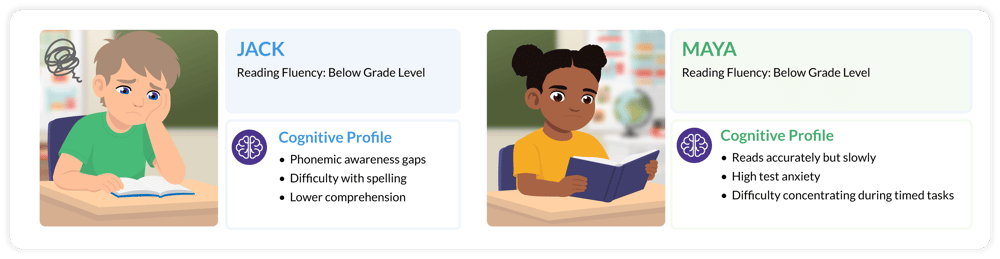
Consider two third-graders who score below grade level in reading fluency. One has phonemic awareness gaps that have compounded since kindergarten. The other reads accurately but slowly because anxiety makes it hard to concentrate during timed tasks. Assigning both to the same phonics intervention helps one student and frustrates the other. Without the cognitive data in addition to the academic data, the underlying reasons are not known, and the same intervention gets applied to very different problems.
Additionally, academic data tends to be retrospective. By the time a student’s file shows a downward trend, a student may have experienced a year or more of unmet need. Schools that rely solely on grades and benchmark scores are, in effect, watching the rearview mirror while trying to navigate the road ahead.
Building Whole Learner Profiles
A Whole Learner Profile is more than a dashboard. It's a longitudinal, multi-dimensional record of a student's strengths, challenges, patterns, and growth — one that gives any educator who works with that student a running start rather than starting from scratch every year.
The most complete student profiles integrate data from three domains:
 Academic (What students know and can demonstrate)
- Universal screening benchmarks
- Diagnostic assessment results
- Grades and course history
- Standardized test scores
- Growth over time
- MTSS/Intervention records
- 504 / IEP documentation
Behavioral (How students engage)
- Attendance and tardiness patterns
- Office discipline referrals
- Participation and engagement patterns
- Social-emotional screening data
- Teacher observation logs
Cognitive Skills (How students learn best)
- Executive functions
- Complex reasoning
- Working memory
- Processing speed
When these three domains interact continuously and are visually connected, the Whole Learner profile becomes easily accessible and useful for instructional planning, MTSS problem-solving, eligibility decisions, and family conversations.
A complete profile importantly captures and highlights strengths, not just deficits. A student who struggles with reading fluency may show exceptional spatial reasoning. A student with attention challenges may demonstrate remarkable creative thinking in open-ended tasks. Strength-based profiles shift the question from "what's wrong with this student?" to "what does this student need, and what can we build on?" This clears the way for highly effective and engaging strengths-based learning for all students.
The [Often] Missing Piece: Cognitive Data Reveals How Students Learn
When you think of cognitive data or cognitive assessments, you might only think of IQ tests and screening for gifted programs. However, cognitive assessments are so much more; they provide data around the whole child. They measure the underlying processing skills that make learning possible — the why behind the what. When cognitive skills are strong, students can absorb, retain, and apply new information with relative ease. When they're underdeveloped or inconsistent, even well-designed instruction may not reach a student as intended.
Unlike achievement, cognitive assessments measure learning capacities in the domains of:
- Complex reasoning (verbal, abstract, and spatial)
- Executive functions (attention, working memory, and flexible thinking)
- Memory (visual and verbal)
- Speed (visual processing and visual motor)
 These diverse capacities are essential for learning across contexts and together are the most powerful single predictor of academic achievement, whether measured by grades or standardized academic achievement tests (Bergold, Sebastian & Steinmayr, Ricarda, 2018). Aside from their predictive capability, cognitive assessments can provide clear insight into the most likely reasons for gaps in learned knowledge.
As such, collecting cognitive data as part of routine universal screening can inform instruction at all levels and support Tier 1 and Tier 2 decisions without a formal evaluation. Many schools use brief, validated cognitive screeners, such as MindPrint, as part of their comprehensive data collection strategy. This data informs MTSS intervention design and helps teams decide when a fuller evaluation is warranted. It doesn't replace that evaluation, but it makes the referral more targeted and better-documented.
How Whole Learner Insights Support MTSS and Equity
Multi-Tiered Systems of Support (MTSS) is, at its core, a data-driven framework. Its effectiveness is directly proportional to the quality and completeness of the data schools use to make decisions. When that data is limited to academic scores, MTSS teams end up making consequential decisions with incomplete information.
Whole Learner Insights strengthen every tier of the MTSS framework:
Tier 1: Better core instruction for all students.
Cognitive and behavioral data help teachers understand the range of processing styles present in a classroom, enabling more intentional universal design. When a teacher knows that a significant portion of his students show working memory challenges, he can restructure his whole-group instruction before anyone falls behind.
Tier 2: Smarter grouping and intervention matching
Whole Learner data helps MTSS teams group students into interventions based on shared learning needs — not just similar performance levels. Two students at the same reading level may need very different Tier 2 supports depending on whether their challenge is phonological, fluency-based, or comprehension-driven, and whether executive function or working memory is a contributing factor.
Tier 3: More informed eligibility decisions
When schools are considering special education evaluation or intensive intervention, a complete cognitive profile reduces the time between concern and action — and produces more complete documentation of a student's pattern of strengths and needs. This strengthens both the referral and the resulting IEP.
A More Equitable Lens on Student Potential
When Whole Learner data is collected systematically across all students (not only those who have already been flagged), it also creates a more equitable identification process. Traditional achievement tests are heavily language-based — even math and science sections often require strong reading skills. This disproportionately disadvantages students from lower-income and non-English speaking backgrounds who may have had less exposure to academic English language.
How Schools Use Whole Learner Insights to Personalize Learning
Personalized learning has become a goal in nearly every strategic plan, but the execution is often limited to adaptive software that adjusts the difficulty of the next question. Genuine personalization requires knowing how a student processes information — not just what level of content they're ready for.
Schools that have integrated Whole Learner Insights into their practice describe a shift in how teachers talk about students. Problem-solving team conversations move from "she's not trying" to "she has the skills but needs the processing load reduced." Intervention planning moves from "let's add another round of the same program" to "let's address the underlying working memory challenge that's limiting her ability to retain what the program is teaching."
The schools that personalize learning best have moved cognitive data out of the school psychologist's office and into the shared data system that classroom teachers, interventionists, Special Education teachers, and MTSS coordinators access routinely. Specific academic, behavioral, and cognitive data doesn't belong to any single educator — it belongs to the student's support team, and it's most useful when everyone on that team can see it and act on it.
Whole Learner Insights: Practical, Affordable, Scalable, and Effective
Cognitive assessments historically required a one-on-one session with a certified clinician, which was expensive and time-consuming. That's changed. Online adaptive assessments like MindPrint's can be completed in about an hour, administered to groups, and don't need to be repeated often (typically every three years). Results come back immediately with actionable guidance for teachers.
With Otus and MindPrint, schools gain a well-designed system that translates cognitive, academic, and behavioral data into actionable Whole Learner Insights and Profiles that provide teachers and educators with one clear, connected view of each learner. Otus AI takes this one step further by analyzing all of the data together to surface patterns, suggest next steps, and recommend supports aligned to how each student learns. This powerful solution gives teachers what they've always needed: not just a score, but a reason, and a path forward for every single student.
Request a demo!
See exactly how Otus can help your school accelerate student growth and improve student outcomes – all while saving educators time.