

Sep 3, 2026
When most people think of assessments, they think academic: formative, summative, and diagnostic. But traditional academic data has a critical blind spot: it only measures what students have learned, not how they learn best. Without that piece, even the most data-driven educator is working with an incomplete picture.
The Rise of Academic Assessments
For over 150 years, public schools have been collecting data on students: attendance, test scores, graduation rates, grades. And for a long time, that felt like enough. Then came No Child Left Behind, which linked standardized testing with accountability. In recent decades, technology developments have led to putting a classroom device in every student's hand. And now, AI has become readily available to streamline data and identify weaknesses in learning in record time.
Schools are swimming in academic data like never before. This access to academic data is great, but there’s one big problem: more data hasn't meant better teaching.
The Goal of Assessments: Data-Driven, Efficient, and Effective Instruction
 Assessments exist for one reason: to improve learning. They set the instructional feedback loop in motion:
- Measure what students know
- Identify learning gaps
- Inform and adjust instruction
However, knowing what a student hasn't mastered tells educators almost nothing about how to help them master it. This is the fundamental limitation of academic data. When only academic data is available, there are too many educated guesses used to inform and adjust instruction.
True data-driven instruction requires assessments. Not just their scores, but how they think, process, and learn. That means going beyond academic data to embrace whole learner insights: the cognitive and learning profile data that tells educators why gaps exist and how to close them. Only then can assessment fulfill its actual promise, not just measuring success and failure, but unlocking an effective path forward for every student.
Academic Data Alone Leaves Teachers Without Clear Answers
Think about what happens after a student scores poorly on a quiz. The teacher sees a bad grade, but then what? Academic data generally fails in providing rich diagnostic feedback regarding student thinking. Traditional tests and assessments are great at revealing that a student is struggling, but they offer almost no clues as to why. Consider what traditional tests actually reveal about a struggling student:
- Did they misunderstand the concept? Academic data can't tell you.
- Did they run out of time? Academic data can't tell you.
- Did they misread the question entirely? Academic data can't tell you.
This is why test scores aren’t enough. Without whole learner insights (generated by academic, behavioral, and cognitive data), teachers are left trying to close learning gaps without really knowing where those gaps come from, essentially guessing at solutions to problems they can't fully see. Educators and students deserve better.
Cognitive Data Fills The Gap Academic Data Leaves Behind
While academic data identifies the problem, cognitive data explains it. By measuring how a student's brain actually works (i.e., how they learn best through things like memory, attention, processing speed, and reasoning), educators get a window into the why behind inconsistent performance :
- A student who freezes on timed tests? Likely slower processing speed.
- A student who understands the lesson but blanks on the exam? Probably weaker working memory.
- A student whose performance swings drastically from one assessment to the next? Maybe executive function or attention issues, not carelessness or effort.
These aren't mysteries. They're measurable. And once educators have that cognitive data, they're not guessing anymore: their instruction is informed and intentional.
From Data to Action: What Cognitive Insights Make Possible
When cognitive data is easily accessible, instruction stops being reactive and starts being strategic. A teacher is no longer looking at a struggling reader and reaching for a generic intervention. She's looking at a whole learner — with a specific cognitive profile that points directly to the strategies most likely to work for that student's brain.
That's the difference between going through the motions and making real progress. Academic data shows you the problem. Cognitive data shows you the solution. Together, they give educators something they've never had before: a complete picture of every learner and a clear, confident path forward for each individual student.
When the Data Doesn't Add Up, Cognitive Insights Explain Why
Every teacher knows the student who gets it in class but falls apart on tests. Aces one assessment, bombs the next. Without cognitive data, those patterns are confusing and frustrating. With it, they can make immediate sense.
Cognitive insights explain the variability that academic scores never could:
- Why a student retrieves information differently under pressure
- Why attention breaks down in certain formats
- Why effort and outcome don't always match
When educators can explain what they're seeing, they're far more likely to trust the data, communicate it confidently to families, and act on it in ways that advance students forward.
That's what looking at the whole learner makes possible. It’s no longer just student data, but now it’s actionable learning insights. No more data for its own sake: now it’s better data transformed to insights that impact every learner.
The Hidden Equity Problem in Academic Data
Capturing cognitive data helps level the playing field for all students as well. Standard academic assessments (both formative and summative) are often heavily tied to reading ability, even when reading isn't the skill being tested. That means a student who thinks brilliantly but reads slowly will consistently look like a low performer on paper. For lower-income students, who are disproportionately affected by this bias, the consequences are real and lasting. High-potential STEM students get overlooked. Creative thinkers get labeled as struggling learners.
Cognitive data changes that. It reveals strengths that grades and test scores simply can't see, giving every student a fair shot at being truly understood.
The Bottom Line: Academic Data Alone Isn't Enough
Academic data has served an important purpose, but it has never been able to tell the story of the whole child. It shows us outcomes, not origins. Symptoms, not causes. In a world where we have the tools to understand not just what students know but how their brains actually work, settling for academic data alone is no longer good enough. Every student deserves to be fully seen, and every educator deserves the full picture.
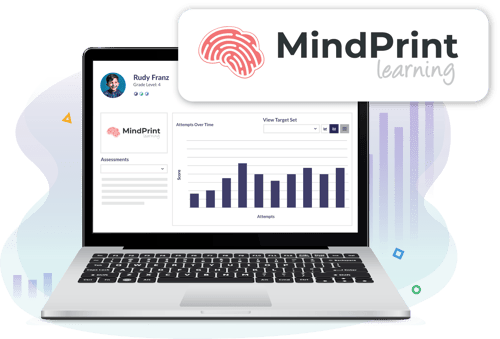
That's exactly what becomes possible when academic and cognitive data work together. Adaptive assessments like MindPrint make capturing cognitive data simple and accessible for all students. The MindPrint Assessment reveals how students learn by measuring strengths and needs across key cognitive domains, including Complex Reasoning, Memory, Executive Function, and Processing Speed. When those insights live alongside academic data inside one platform like Otus, educators finally have what they've always needed: a complete, actionable picture of every learner.
Only then do educators have what they need. Instruction no longer includes guesswork. Intervention is not one-size-fits-all. Now, educators can provide smarter, more confident teaching for every student, every time.
Request a demo!
See exactly how Otus can help your school accelerate student growth and improve student outcomes – all while saving educators time.