

Aug 3, 2026
.png?width=250&height=250&name=Nancy-Weinstein-MindPrint%20(1).png) In the pre-Internet world, content knowledge was king, i.e., students with the strongest memory stood out the most (think Jeopardy! Champions). The internet changed that. While memory is still important, critical thinking, or the ability to make connections and solve problems, determines who rises to the top. In an AI-driven world, we are likely to see yet another shift. Reasoning and recall still matter, but it is flexible thinking, or the ability to take feedback, adapt, and see beyond what AI chatbots like Claude can provide, that will determine exceptionality. And yes, that is exactly where Claude needs help.
In the pre-Internet world, content knowledge was king, i.e., students with the strongest memory stood out the most (think Jeopardy! Champions). The internet changed that. While memory is still important, critical thinking, or the ability to make connections and solve problems, determines who rises to the top. In an AI-driven world, we are likely to see yet another shift. Reasoning and recall still matter, but it is flexible thinking, or the ability to take feedback, adapt, and see beyond what AI chatbots like Claude can provide, that will determine exceptionality. And yes, that is exactly where Claude needs help.
We evaluated Claude through the lens of MindPrint, a cognitive assessment that maps students’ learning strengths across memory, reasoning, attention, and more. As the results below show, Claude can do many things well, but students with strong skills will still outperform Claude in many areas – and educators will need to know which skills to prioritize to help students thrive in an AI-driven world.
Claude’s MindPrint Profile
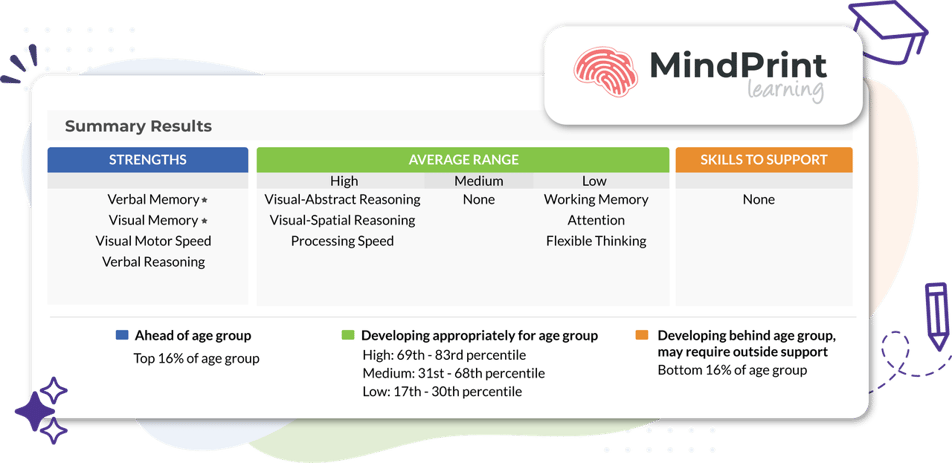
Strengths/Above Average:
- Memory: No surprise here. Claude showed an exceptional ability to remember and retrieve information on any topic or format. No human can come close. Since foundational knowledge is key to Reasoning, this is a key strength for Claude.
- Complex Reasoning: Claude did very well on all three skills, but with notable variability. Claude’s Verbal Reasoning was strongest – with a well-structured prompt, Claude can answer almost any question correctly. But Claude sometimes falters on more nuanced challenges and visual problems and manipulations, suggesting that Claude has some ways to go in Visual Reasoning.
- Processing Speed: Undoubtedly, Claude is faster than any human at solving complex problems, but that doesn’t mean that Claude is always most efficient. For straightforward questions, a quick search and maybe your own brain are still faster and better.
Below Average:
Like many students who take MindPrint, Claude didn’t have any skills that were absolute weaknesses (i.e., bottom 16%), but Claude’s below-average skills revealed where most students will actually be better than Claude. In short, don’t rely on Claude for tasks dependent on these skills. And students who are also weaker in these skills will benefit from explicit instruction in how to use Claude, so they too can thrive in an AI world.
- Executive Functions (Attention & Working Memory): Claude was surprisingly sloppy at keeping track of details in a multi-step project. While Claude apologized for making mistakes, Claude’s lack of sustained focus could be a source of frustration and errors if you aren’t careful.
- Flexible Thinking: While Claude’s Flexible Thinking was good, it was undoubtedly Claude’s lowest skill. Claude was unable to pivot without explicit direction, suggesting clear limitations on creative problem-solving without a flexible human to guide them.
So, what does this all mean?
Claude’s results, like a student’s MindPrint Profile, offer a mind map of strengths and areas to support, not a single score. Claude is a powerful assistant for building content knowledge and even tackling complex reasoning. But it still needs a human in the loop, especially when it comes to staying on track over multiple steps or adapting when the first approach doesn’t quite work. Those are exactly the skills we should be helping students develop; the ones no chatbot can replace.
Related Resources
Request a demo!
See exactly how Otus can help your school accelerate student growth and improve student outcomes – all while saving educators time.