

Sep 3, 2026
 At some point, every teacher has asked themselves the question: Why is this student struggling? They've checked the test scores. Reviewed the grades. Tried different approaches. Something isn't adding up.
The truth is, academic data can only tell you so much. It shows you what a student knows — but not how they learn, or why a concept that makes perfect sense to one kid is completely lost on another.
That's where cognitive assessments come in. They measure the skills behind the learning: memory, attention, reasoning, and executive function. And research backs this up — cognitive skills are the strongest single predictor of academic achievement.
Most schools just don't have a reliable way to measure them. Yet.
This blog covers what cognitive assessments measure, how they're different from the other tests in your toolkit, and how cognitive data can help educators make smarter decisions for every student in their classroom.
What is a Cognitive Assessment
Historically, for most schools, getting insight into how students learn meant one thing: a lengthy battery of assessments administered one-to-one by a school psychologist. The findings would land in a report — and rarely reach the teacher in any actionable way.
That's changed. Thanks to advances in learning science and technology, cognitive assessments can now be delivered online, self-administered, and completed in as little as an hour. So what exactly is a cognitive assessment? It's an evaluation of the brain's core mental functions — memory, attention, language, executive functions, and reasoning — and it's now accessible to every student in grades 3–12, not just those who've already been flagged for support.
What Does a Cognitive Assessment Measure?
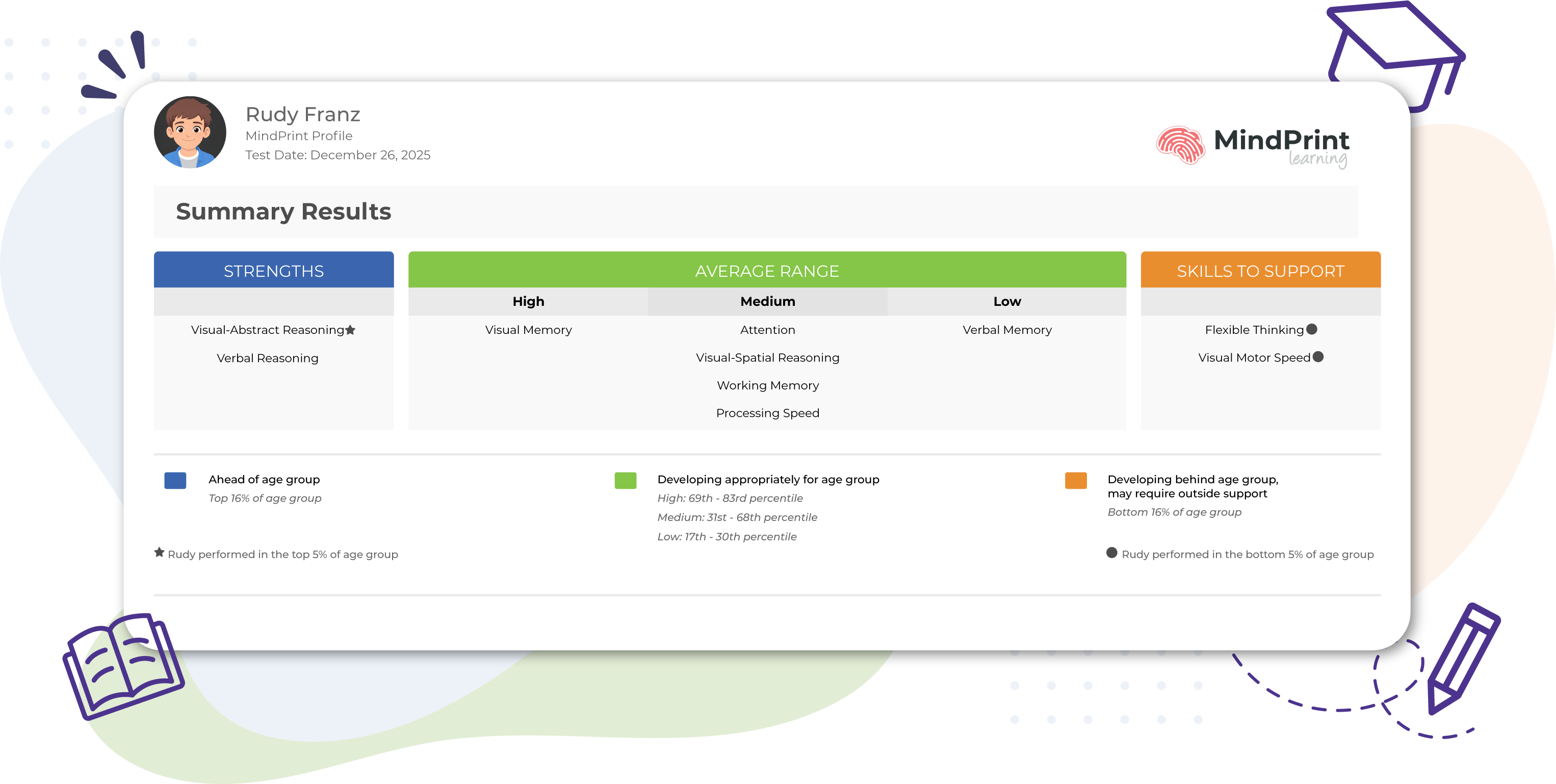
Unlike student achievement assessments that measure academic learned knowledge and acquired skills, cognitive assessments measure learning capacities in the domains of complex reasoning, executive functions, memory, and speed. These domains encompass the cognitive skills that are most relevant to academic success:
Complex Reasoning is your ability to understand and analyze new information and solve problems.
- Verbal Reasoning: Understanding and applying what you read and hear.
- Abstract Reasoning: Understanding non-language-based information, including images, numbers, shapes, and patterns.
- Spatial Perception: Visualizing and understanding how objects relate in space.
Memory is how easily you can store new information and efficiently recall it at a future time.
- Verbal Memory: Remembering what you read or hear.
- Visual Memory: Remembering formulas, figures, and pictures or other non-language-based information.
Executive Functions refer to how efficiently you can complete your assignments (regardless of how well you know and understand the information).
- Attention: Sustaining focus to work accurately and efficiently.
- Working Memory: Juggling information in your head for multi-step problem solving or tasks.
- Flexible Thinking: Adapting to unfamiliar information or situations.
Speed is how efficiently you work to complete assignments thoughtfully within the expected time.
- Processing Speed: Responding by balancing speed and accuracy.
- Visual Motor Speed: The rate of seeing and physically responding.
Understanding the students’ cognitive development in these domains and skills is key to unlocking how students learn best.
How is a cognitive assessment different from a standardized test?
Cognitive testing and academic testing are both essential for K-12 education and both support educators in ensuring students get the most effective education possible.
|
Cognitive Assessments |
Academic Assessments |
|
|
Goal: |
Identify how a student learns. |
Identify what a student has learned. |
|
Measures: |
Executive functions, reasoning, memory, and processing speed. |
Mastery of skills such as reading comprehension, math, writing, and science. |
|
Cadence: |
Results are valid for multiple years. |
Often: Annually and multiple times per year. |
|
Use Cases: |
|
|
Cognitive assessments are not designed to replace academic assessments. Instead, they complement them by providing insight into how students learn.
By helping educators identify the underlying causes of academic performance, cognitive assessments support:
- More targeted interventions
- Better instructional planning
- Increased student self-efficacy
- Stronger learner agency
- More meaningful use of all assessment data
Ultimately, the goal isn't simply to collect more information about students. It's to use all accessible information, including cognitive data, to inform teaching and create learning experiences that help every student understand their strengths, address their challenges, and reach their full potential.
Why Cognitive Assessments Matter for Instructional Decisions
Traditional academic assessments tell us what a student knows. Cognitive assessments help explain why a student is performing the way they are. By identifying underlying cognitive strengths and needs, educators can make more informed instructional decisions and provide support that addresses the root cause.
Consider these common classroom scenarios and how different students’ cognitive profiles can help lead to better support and instruction for students.
|
Cognitive Insight |
Likely Reason |
Actionable Next Step |
Long-term Value |
|
Amy has weaker-than-average memory skills |
Amy had difficulty retaining the breadth of material for a longer test and/or forgot what she previously learned |
Encourage spaced repetition of all material throughout the chapter to ensure long-term retention |
Amy learns to space studying and avoid long-term learning gaps across subjects |
|
Todd has weaker reasoning skills |
Todd didn’t learn deeply, but gaps are missed on brief quizzes and become obvious on in-depth tests |
Re-teach using Todd’s strongest reasoning skill to ensure mastery |
Todd avoids long-term learning gaps and has a deeper understanding |
|
Shira has weaker executive functions |
Shira can focus for shorter quizzes but has difficulty sustaining focus for longer assessments |
Require Shira to show and check all work to catch avoidable mistakes and take regular breaks |
Shira learns to self-monitor and manage heavier workloads in higher grades |
|
Cognitive Insight |
Likely Reason |
Actionable Next Step |
Long-term Value |
|
Bruce has stronger verbal reasoning but weaker abstract reasoning (or vice versa) |
Bruce more naturally understands what he reads but has more difficulty when he needs to interpret numbers, diagrams, or charts (or vice versa) |
Provide Bruce with opportunities to digest challenging concepts in his stronger skill (e.g. provide a text description of the diagram) |
Bruce learns to transform content into his more natural format when working independently (e.g. describe the diagram in their own words) |
|
Avi has weaker attention or working memory |
Avi makes “careless errors” when tired; depending on the chapter topic and time of day he might underperform |
Teach strategies to stay focused in class and how to check work |
Avi develops self-awareness of focus and learns to more effectively self-manage |
|
Charlie’s memory skills are not as strong as his reasoning skills |
Charlie understands a lesson but forgets; this can be a bigger challenge in more cumulative subjects, like math and foreign language |
Provide Charlie with structured repetition to review core material regularly, so it is not forgotten |
Charlie learns to review key content regularly, so it is not forgotten, and appreciates the difference between understanding and remembering |
|
Cognitive Insight |
Likely Reason |
Actionable Next Step |
Long-term Value |
|
Ben is weak in abstract and/or verbal reasoning |
Ben is struggling to understand the content and might be embarrassed to ask for help or has “given up” |
Provide Ben with small group support or one-to-one intervention to fill gaps and boost self-confidence |
Ben learns they can succeed, but might need to ask for help |
|
Maya is exceptional in abstract reasoning and/or verbal reasoning |
Maya is bored or does not see the value; often, a student has a weaker attention or memory skill that causes frustration |
Re-engage Maya by acknowledging their strength and finding opportunities to tie that strength to their interests |
Maya sees purpose in learning and develops interests that use their strengths |
|
Dylan has weak attention |
Dylan cannot focus in class for even short periods of time, particularly in subjects that are not of natural interest; he stops trying to focus and disengages |
Provide Dylan with ways to sustain focus, including frequent breaks, stretching, and meditation; provide class notes so he does not fall behind |
Dylan develops self-awareness of focus and learns to use strategies |
As the examples above demonstrate, K-12 cognitive assessments can offer additional benefits that extend well beyond filling the gaps left by academic assessments. They ultimately lead to more engaged students, better learning outcomes, and stronger learner agency.
The question then becomes: how do you find the right tool to make all of this possible?
What District Leaders Should Look for in a Cognitive Assessment
It is critical for district leaders to find a cognitive assessment tool that aligns with the end goal: smarter instructional decisions and greater student achievement. When evaluating cognitive assessments, district leaders likely want to analyze the tool’s:
- Validity and Reliability: Ensure the assessment is evidence-based and accurately measures what it intends to measure and yields consistent, dependable results.
- Actionable Data: Verify that the assessment provides educators with quick, clear insights and specific next steps to drive instruction and intervention.
- Tech Alignment: Confirm the assessment can integrate smoothly with your district's existing tech infrastructure.
- Big-Picture Reporting: Assess whether the assessment aggregates data effectively alongside your other assessment tools so district leaders can track long-term trends and student achievement
- Professional Development: Look for comprehensive support and training programs to help educators interpret and use the data.
The End Goal: Smarter Instructional Decisions & Greater Student Achievement
More data isn't the goal. Better decisions are.
Cognitive assessments give educators something academic data alone never could: a window into how students learn. When that data is accessible, actionable, and integrated into the tools educators already use, it can drive meaningful change in the classroom.
That's exactly what MindPrint is built to do. In just one hour, MindPrint gives educators a complete picture of each student's cognitive profile — their strengths, their challenges, and the specific strategies most likely to help them succeed. When MindPrint data lives alongside academic performance, attendance, and intervention records in the Otus platform, the picture gets even clearer. Educators can see the whole learner and make smart decisions that are grounded in evidence.
Request a demo!
See exactly how Otus can help your school accelerate student growth and improve student outcomes – all while saving educators time.