

Sep 7, 2026
In the Debate Over Whether Teachers or AI Accelerate K-12 Achievement More, What If the Answer Is Both?
Originally featured on Edtech Digest
Eleven years in the classroom taught me the importance of cultivating relationships and establishing a strong classroom culture before launching into instruction, because students learn best when they feel seen, understood, and supported. In the decade-plus since I transitioned to edtech, the number of instructional models and tools continues to explode, but the fundamental truth about how students learn best has not changed.
This gets to the heart of a question facing public education leaders: Should schools pursue AI-assisted, on-demand learning or human-centered instruction to accelerate academic achievement and close learning gaps?
What AI can and cannot do in guided learning environments
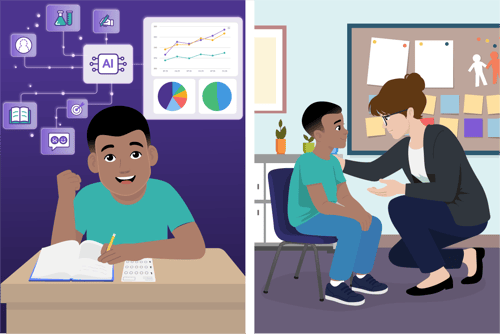 Educators spend hours designing learning experiences and curating sources of information. Then they go in front of a class to engage students and provide high-quality feedback, all while observing opportunities to differentiate instruction and anticipating additional needs.
AI assistants can do some of these tasks too—and more, like providing immediate feedback to an entire class or analyzing performance data year over year.
What AI cannot do is adapt the physical environment to decrease extraneous load. AI cannot be in the room to feel the energy and read the body language of students. AI cannot recognize when a student’s cognitive resources have been depleted to the point where they need a break.
These missing elements are important for young learners, who need a high level of structure to free up mental processing power for complex or unfamiliar concepts. When instruction is weak or unmediated, students’ working memory can become overloaded. The result is uneven mastery.
Proponents of AI-powered learning sometimes point to Montessori classrooms as self-regulated and self-directed learning environments. Students work at their own pace, often in very individualized settings, which offer the illusion of educational free rein. However, the Montessori model is highly structured. Guides offer specially designed materials and introduce ever-more-challenging sequences according to each child’s progress.
By contrast, human guides in classrooms focused on AI integration serve a different role. They are intended to be mentors and motivators, but not to instruct or teach. The software does that by adapting to the student’s level, determining the pace of lessons, providing feedback, and tutoring as appropriate.
Student experiences hinge on people and places
.png?width=500&height=283&name=Image-Blog-Teachers-or-AI-Image2%20(1).png) Research has shown everyday events within learning environments can activate or alleviate stress hormones, contribute to emotional ups and downs, and impact attention and memory. Teachers have some control over these factors—and over the interpersonal relationships to mitigate the effects of stress.
Research has shown everyday events within learning environments can activate or alleviate stress hormones, contribute to emotional ups and downs, and impact attention and memory. Teachers have some control over these factors—and over the interpersonal relationships to mitigate the effects of stress.
Traditional classroom settings have been studied to understand what characteristics help or hinder learning. For example, spaces designed for cognitive activities need to support attention, body movement, social interactions, and solitude. Sensory inputs like color, density, and noise level have an impact on self-regulation, attention, and learning capacity.
Trained teachers play a vital role in helping students navigate these environments so they can devote their full cognitive resources to learning.
As students get older and better at taking responsibility for their progress, teachers are still needed to foster curiosity, encourage peer collaboration, help ideate and plan next steps, and monitor performance holistically — because learning deepens when students think alongside each other, not just independently.
Classrooms where students work independently on devices while wearing headphones have a different dynamic. Personalization of lessons is a given. Human interaction and ambient input is not.
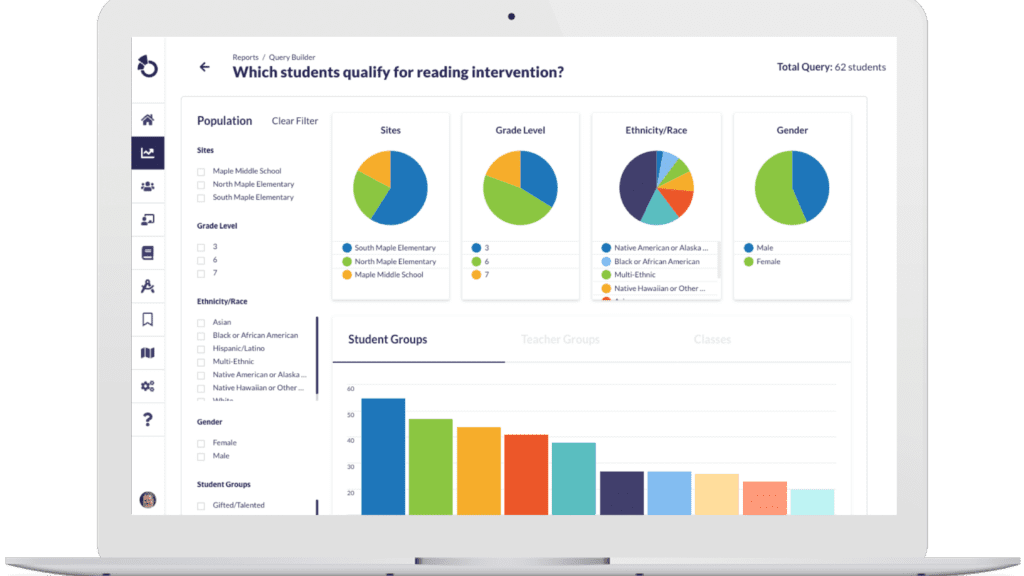
Supporting each type of environment requires a strong foundational knowledge about students’ achievement, behavior, attendance, and more. This is where comprehensive data platforms come in. Having a single source of data saves time and effort while helping educators identify potential gaps and discern strategies to address them.
In support of meaningful differentiation powered by data
School leaders’ thinking about progress, feedback, and evidence of learning is evolving, and innovations like standards-based grading, competency-based learning, and multi-tiered systems of support would not be as robust as they are without systems for comprehensive data collection, analysis, and reporting.
But none of them would be effective without a strong human component.
The importance of teacher-led interactions is one of the reasons my co-founder and I started Otus in 2014. The time efficiencies created by automating administrative tasks and uniting data give teachers more opportunities to connect with students.
In the coming years, schools’ ability to see what works best for each student will lead to more meaningful differentiation and instruction. Some students will undoubtedly excel through using accelerated learning via AI-powered, personalized software for a portion of the school day. Others will benefit from talking through new ideas with teachers and peers.
For school leaders, providing the edtech data backbone to support both human-centered and AI-powered learning will strengthen opportunities for all students.
Chris Hull
Co-founder and President
Otus
As a former educator, Chris understands both the challenges and the rewards of the classroom. He believes every student should have the opportunity to succeed, and that begins by equipping educators and school communities with the tools and data they need to make a meaningful impact on students’ lives.
Request a demo!
See exactly how Otus can help your school accelerate student growth and improve student outcomes – all while saving educators time.