

Oct 8, 2026
A professional learning community (PLC) team flags a group of struggling readers on Tuesday, while the school’s multi-tiered system of supports (MTSS) team identifies a slightly different, overlapping group of readers that Thursday. Same building, same week, same underlying problem, two teams working from two different pictures of it.
If both teams already know what MTSS is and how to run a PLC, where does the disconnect come from? Usually somewhere operational, like who’s in the room, what data gets reviewed, and how often the two structures talk to each other.
This guide covers exactly that.
PLC, RTI, and MTSS: What’s the difference?
These three terms get used almost interchangeably in casual conversation, which can cause real confusion when it comes time to build a meeting structure.
|
|
PLC |
RTI |
MTSS |
|
What it is |
A collaborative team structure for teachers |
An academic intervention process, typically reading or math |
A schoolwide framework covering academics, behavior, and social-emotional needs |
|
Primary question |
What are students learning, and how do we know? |
Is this student responding to intervention? |
Which tier of support does this student need, across all areas? |
|
Scope |
Grade-level or content-area team |
Individual students flagged for academic support |
Every student, at every tier, schoolwide |
|
Typical data reviewed |
Common formative assessment, unit data |
Progress monitoring on a specific skill |
Universal screening, progress monitoring, behavior and attendance data |
Response to intervention (RTI) is often the academic engine inside a larger MTSS framework. MTSS expanded RTI to include behavior and social-emotional support alongside academics. A PLC is a team structure that can feed data into either one. None of the three replaces the other, and that’s exactly where alignment problems often begin to brew.
For common pitfalls to watch for as this structure gets built out, see our guide to PLC implementation mistakes.
Can a PLC replace a separate MTSS team?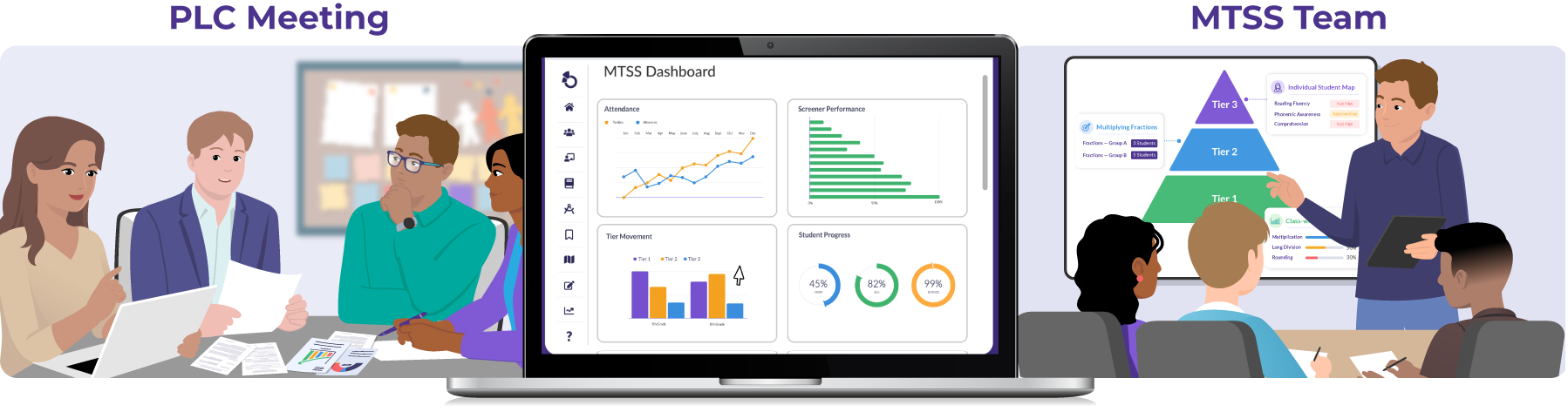
No, and trying to do so would likely stretch a PLC past what it’s built for. A PLC is organized around a grade level or content area. MTSS decisions, especially Tier 2 and Tier 3 placement, often require people outside that team, such as a school psychologist, a counselor, a special education coordinator, or an interventionist who works across grade levels.
A better approach is to treat the PLC as the place where academic data first surfaces, and the MTSS team as the place where tier-specific decisions get made and tracked. The two need a clear, consistent connection point more than they need to meld into one team.
How PLCs fit into an MTSS framework
The clearest way to think about this is by tier.
Tier 1 is where PLCs are already doing the most natural MTSS-aligned work, even without explicitly calling it that. Common formative assessment data, reviewed in a PLC meeting, is universal screening in practice. When a PLC asks “How will we know if students learned this?” that question is functionally identical to a Tier 1 MTSS check.
Tier 2 and Tier 3 are where schools are most likely to lose the thread. These conversations require progress monitoring data on a smaller group of students, possibly collected on a different cadence than the PLC’s usual assessment calendar. If the PLC standard meeting structure doesn’t have a slot for this kind of data, Tier 2/3 review either gets rushed at the end of a meeting or nixed entirely.
The fix is structural, building a recurring Tier 2/3 data review directly into the PLC calendar, rather than treating it as a bolted-on afterthought.
If your district is still building out its broader MTSS structure, check out how Otus supports that work beyond the PLC.
The 4 critical questions, mapped to MTSS
In the 1980s and ‘90s, a high school principal outside Chicago kept noticing that some teacher teams got dramatically better results than others, and started digging into why. That principal was Richer DuFour, and what came out of his digging were four deceptively simple questions. Those four questions already map onto MTSS almost exactly, practically dovetailing without much reshaping. Spelling out that connection explicitly helps a PLC use its existing structure instead of building a new one from scratch.
- What do we want students to know and be able to do? This is the Tier 1 foundation. The standards and expectations every student is taught, regardless of tier.
- How will we know if they’ve learned it? At Tier 1, this is universal screening and common formative assessment. At Tier 2 and 3, this becomes progress monitoring, more frequent, more targeted, tied to a specific intervention.
- What will we do if they haven’t learned it? This is the tier-movement question. A PLC answering this well is doing the same work an MTSS team does when deciding whether a student needs to move into Tier 2 or Tier 3 support.
- What will we do if they already know it? Often overlooked in MTSS conversations, this question covers enrichment, which is just as important to a complete tiered system as intervention.
A PLC is already asking the right questions; the alignment work is just making sure Tier 2 and Tier 3 data gets pulled into that same conversation.
What a PLC meeting looks like when reviewing Tier 2/3 data
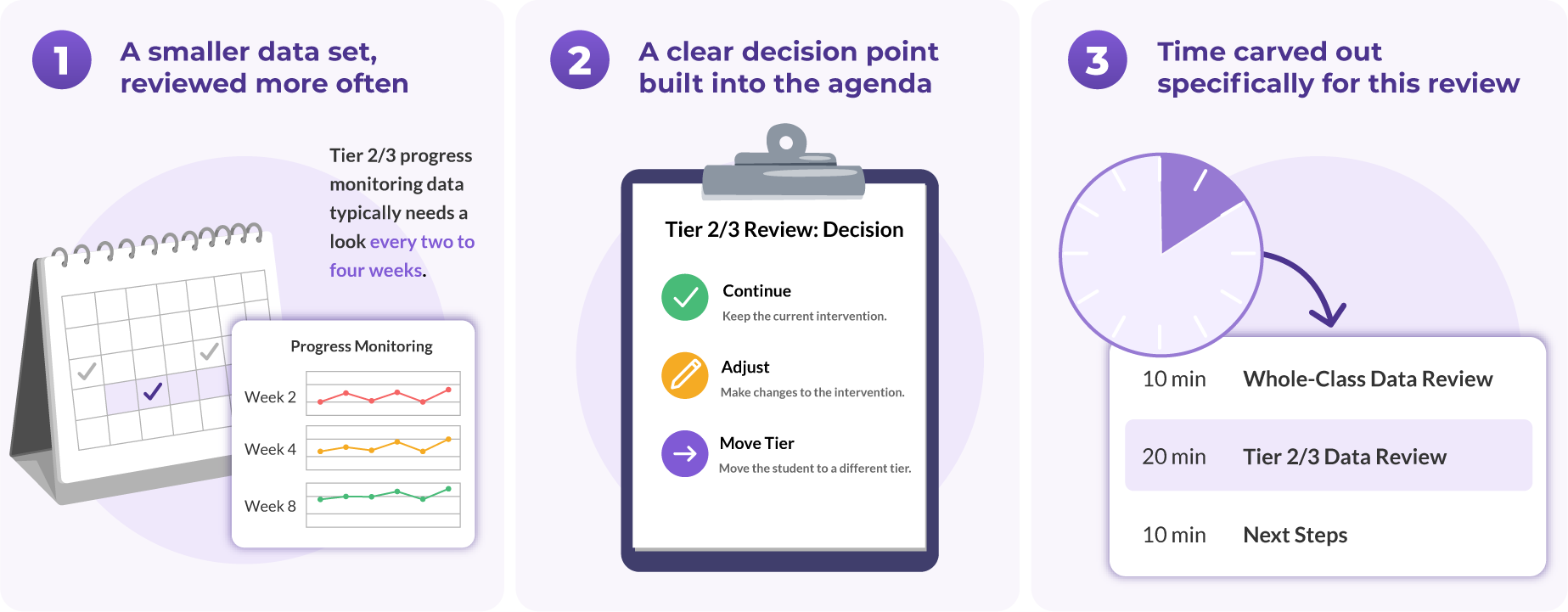
A Tier 2/3 data review needs a different rhythm than a standard PLC meeting built around whole-class data. Three structural differences worth considering:
- A smaller data set, reviewed more often
Tier 2/3 progress monitoring data typically needs a look every two to four weeks, well short of a full grading period. - A clear decision point built into the agenda
Every Tier 2/3 review should end with an explicit call to continue the current intervention, adjust it, or move the student to a different tier. - Time carved out specifically for this review
Separate from the whole-class data discussion, so it doesn’t get squeezed out when the broader agenda runs long.
Who should be in the room?
This is where PLC and MTSS team rosters tend to diverge, and where schools most often stumble, swinging too far in one direction or the other.
The classroom teacher belongs in every Tier 2/3 conversation about their own students, since they have context no data point captures on its own. Beyond that, the room should include whoever owns the intervention data, such as an interventionist, an instructional coach, a reading specialist, or an MTSS coordinator. For Tier 3 conversations, or any conversation touching behavior or social-emotional support, a counselor or school psychologist should be looped in as well, even if that means bringing them into part of a standing PLC meeting rather than the whole thing.
The right person showing up for the specific decision at hand is more important than turning every PLC meeting into a full MTSS team meeting.
See our guide for more on PLC roles and responsibilities for more on why role clarity matters.
How often should PLC teams meet for MTSS progress monitoring?
Whole-class Tier 1 data usually fits a PLC’s normal cycle, often every two to three weeks around a common assessment. Tier 2 and Tier 3 progress monitoring needs a tighter cycle, generally every two to four weeks, since these students have less runaway and interventions need faster course correction.
A workable approach is to keep the PLC’s standard meeting cadence for Tier 1 work, and add a shorter, dedicated Tier 2/3 check-in inside or alongside that same cycle, rather than waiting for a separate meeting to get scheduled somewhere else on the calendar.
How Otus supports PLC and MTSS alignment
The biggest operational barrier to PLC-MTSS alignment usually isn’t all that complicated. To pull data across every tier from separate systems into one place for educators to discuss, all within a 45-minute window, is no small feat.
Otus brings assessment data and progress monitoring into a single, standards-aligned view, so a PLC reviewing Tier 2/3 data isn’t waiting on a separate export from another system. The same platform that supports common formative assessment review at Tier 1 also supports the tighter progress-monitoring cycle Tier 2 and 3 require, keeping both conversations inside the same team instead of splitting them across two disconnected processes.
FAQ: PlC and MTSS Alignment
How do PLCs fit into an MTSS framework?
A PLC’s regular data conversations already function as Tier 1 universal screening in practice. The alignment work is building a frequent, recurring review of Tier 2 and Tier 3 progress monitoring data into that existing team structure.
What’s the difference between a PLC, RTI, and MTSS?
A PLC is a collaborative team structure built around a grade level or content area. RTI is an academic intervention process. MTSS is the broader, schoolwide framework covering academics, behavior, and social-emotional support across every tier.
Can a PLC replace a separate MTSS team, or do schools need both?
Schools need both. A PLC is well-suited to surfacing academic data and Tier 1 conversations, but Tier 2 and Tier 3 decisions require people, like counselors or interventionists, who sit outside a typical PLC roster.
How do the 4 critical questions of a PLC map to MTSS?
The first question, around student knowledge and skills, maps to Tier 1 standards and expectations. The second, about knowing if students learned, maps to universal screening at Tier 1 and progress monitoring at Tier 2/3. The third, around what to do if students aren’t learning, maps to tier-movement decisions. The fourth covers enrichment, which applies to every tier.
What does a PLC meeting look like when it’s reviewing Tier 2/3 data?
It typically covers a smaller group of students, reviewed on a two-to-four-week cycle, with a clear decision point built into the agenda to continue, adjust, or change the student’s tier.
Who should be in the room when a PLC discusses interventions?
The classroom teacher, plus whoever owns the intervention data, an interventionist or MTSS coordinator. Tier 3 or behavior-related conversations should also include a counselor or school psychologist.
How often should PLC teams meet for MTSS progress monitoring?
Tier 1 data usually fits a PLC’s standard two-to-three-week cycle. Tier 2 and Tier 3 progress monitoring needs a tighter cycle, generally every two to four weeks, built into or alongside that same meeting structure.
Related Resources
Request a demo!
See exactly how Otus can help your school accelerate student growth and improve student outcomes – all while saving educators time.