

Oct 8, 2026
An agenda is a little promise about how a meeting will go, and an effective PLC keeps that promise. The team knows what the meeting is for and what they’ll walk away with.
This guide gives you a 45-minute agenda template you can use today, shows how it lines up with the four questions at the heart of a PLC model, and compares agendas by meeting type. It also includes a Plan B for the days a fire drill eats your time.
For the bigger picture of how a PLC works, see our Educator’s Guide to PLCs.
What should be on a PLC meeting agenda?
A PLC meeting agenda needs a clear purpose, time to look at evidence, a decision about how to respond, and a plan for following up. This template fits all four into 45 minutes. The times are a starting point, so stretch or shrink them to match your schedule.
A 45-Minute PLC Meeting Agenda Template
|
Agenda Item |
Time |
What To Do |
|
Check-in and Roles |
3 minutes |
Confirm who’s facilitating and who’s taking notes, and rotate both from meeting to meeting. For a refresher on who does what in a PLC, see PLC Roles and Responsibilities. |
|
Last time's commitments |
5 minutes |
What did we say we’d try, and what happened? Closing the loop here keeps a PLC from turning into a series of fresh starts. |
|
Today's focus question |
2 minutes |
Name the one question this meeting exists to answer, like which students haven’t shown growth on this week’s standard. |
|
Dig into the data |
15 minutes |
Look at one assessment and standard, and ask what the evidence shows and why. For a full protocol, see PLC Data Meetings Guide. |
|
Decide the response |
12 minutes |
Plan reteaching for students who haven’t got it and extension for students who have. If a student needs more than a classroom-level response, flag them for the MTSS team. |
|
Next steps and next evidence |
5 minutes |
Give every decision an owner and a date, and agree on what evidence to bring next time. |
|
Reflection |
3 minutes |
Read back what was decided, then ask how the meeting itself went. |
Want a template to edit and print? Our free PLC Toolkit has more on structuring meetings and recording notes.
The 4 questions behind a PLC meeting agenda
Underneath a good PLC agenda sit four questions from Richard DuFour and his colleagues:
- What do we want students to know and be able to do?
- How will we know if they’ve learned?
- How will we respond when they haven’t?
- How will we extend learning for students who already have?
The agenda above is those four questions with a clock on them. Question one gets answered when the team picks its focus standard (item 3). Question two is the data dig (item 4). Questions three and four are the decision (item 5). If an agenda item can’t be traced back to one of the four questions, it’s nothing that can’t be handled via email.
One agenda doesn’t fit every meeting
The template above suits a team looking at results. Other kinds of meetings need a different shape.
|
Meeting Type |
What it's for |
Core agenda items |
What to bring |
|
Planning |
Mapping the next unit or stretch of teaching |
Review the standard; plan lessons and checks for understanding; agree on a common assessment |
Curriculum map or pacing guide |
|
Data |
Responding to recent evidence of learning |
Focus question; data dig; reteach and extension decisions; owners and dates |
Results pulled before the meeting |
|
Assessment design |
Building common assessments and agreeing on what proficient looks like |
Review the standard; draft or revise items; score sample student work together |
Samples of student work at different levels |
|
MTSS check-in |
Reviewing students who got extra support |
Review progress monitoring; decide who moves in or out of a tier; adjust supports |
Progress monitoring data and intervention notes |
|
Reflection |
Looking back on a unit or semester |
What worked and what to change; update team goals |
Unit results and teacher notes |
What the data dig looks like in practice
 The data dig is the block that depends on everything else going right, because somebody has to get the numbers in front of the team before the clock starts. A good dig is narrow, built around one standard and one question. Here’s one way to spend the 15 minutes:
- Read first, talk second (2 minutes). Everyone looks at the same view in silence.
- Find the pattern (4 minutes). Which skill or question tripped up the most students?
- Ask why (6 minutes). Look at the wrong answers and decide what misconception each one points to.
- Name the groups (3 minutes). Sort students into those who need reteaching and those who are ready for extension.
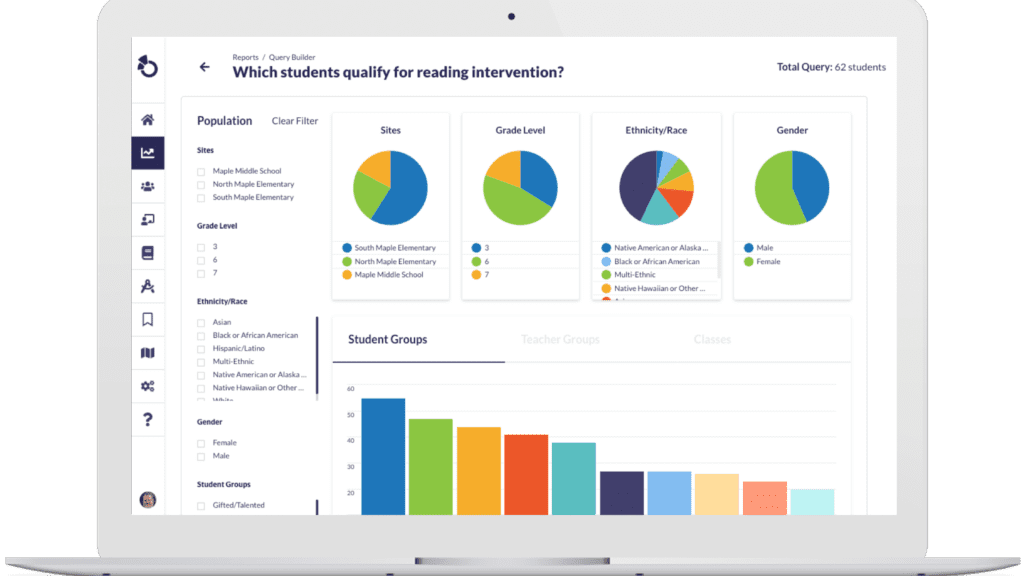
Each step gets easier when the evidence lives in one place. That’s the idea behind Otus: it connects to the tools and data a school already uses and collects, so results and student information are ready when the team sits down. A teacher can open mastery by standard for a common assessment, see how each student did, and group students for reteaching or extension before the meeting starts. Teachers can also ask Otus AI a question in plain English, like which students are struggling on a standard, and check the answer against what they know about their students before making a call.
Send it ahead
An agenda isn’t helpful if you don’t have time to process it and prepare for the meeting. Share it a day or two early with the focus question at the top, and ask everyone to bring one thing, like a piece of student work or a question they’re stuck on. If the meeting will use data, have it ready before anyone walks in. That keeps the meeting’s time for thinking instead of logging in.
When the meeting (inevitably) changes
Fire drills happen. So do sub shortages and the week the data isn’t ready. Keep a 20-minute version of the agenda on hand so the meeting still does its job.
- Check-in (1 minute)
- One commitment from the last time (3 minutes)
- One focus question and one look at the data (8 minutes)
- One decision with an owner and a date (6 minutes)
- Quick read-back (2 minutes)
If the data isn’t ready, swap the data dig for a look at a few pieces of student work, or use the time to plan the next common assessment. Keep a parking lot for anything that surfaces mid-meeting and belongs somewhere else. Sometimes the meeting changes shape midstream. If the data dig shows that students missed a question solely because it was confusing, switch to assessment design at the next meeting and fix the question. A short meeting beats a canceled one.
FAQs
What should be on a PLC meeting agenda?
A check-in, last meeting’s commitments, one focus question, time to look at evidence, a decision about how to respond, and next steps with owners and dates. The template above fits these into 45 minutes.
How long should a PLC meeting be?
There’s no official number. One school’s team may accomplish its goals in 30 minutes, while another may need an hour. Whatever the length, try to keep the structure the same and let the data dig get shorter or longer to fit your specific needs.
How often should PLC teams meet?
Often enough to respond to students while it’s still impactful. Many schools protect time for weekly meetings, and a consistent day and time makes the habit easier to keep. State education departments have weighed in, too. The Colorado Department of Education, for one, recommends dedicated, ongoing meetings in its PLC strategy guide, and its sample plan has PLCs meeting weekly.
What are the four critical questions of a PLC?
What do we want students to know and be able to do? How will we know if they've learned it? How will we respond when they haven't? How will we extend learning for students who already have?
How do you structure an effective PLC meeting?
Open with last meeting’s commitments and one focus question, spend most of the time on the evidence and the decision, and end with an owner and date for every decision.
What’s the difference between a PLC agenda and meeting minutes?
An agenda is the plan, shared before the meeting: the focus question, what to bring, and how the time will be used. Minutes are the record and include what was decided and who owns each next step. A shared document with the agenda at the top and the decisions toward the bottom does both jobs.
Related Resources
Request a demo!
See exactly how Otus can help your school accelerate student growth and improve student outcomes – all while saving educators time.