

Oct 27, 2026
 Kentucky’s assessment and accountability system is entering a new chapter.
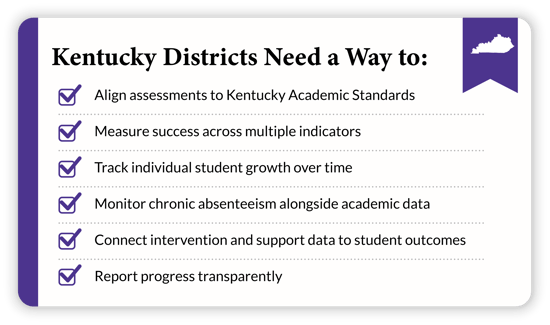
With House Bill 257 signed into law, district leaders are preparing for one of the state’s most meaningful shifts in recent years. The legislation reduces state testing time, places greater emphasis on individual student growth, adds chronic absenteeism as an accountability indicator, and gives districts room to define local measures of quality in partnership with their communities.
Put plainly, it’s an opportunity for Kentucky leaders to think differently about what schools measure and how they respond to student needs.
So, what does HB 257 mean for your district, and how can your team prepare?
A shift toward growth that starts with the individual student
One of the central changes to HB 257 is the move from year-over-year change in accountability indicators to the individual growth of each student. The Kentucky Department of Education (KDE) has described this as a shift away from comparing cohorts of students from one year to the next and toward measuring how students are growing over time.
That’s a significant change for districts.
For school teams, growth-based accountability requires a clearer understanding of each student’s progress and needs. It also requires systems that can connect multiple measures of learning over time, rather than relying on a single snapshot.
This is where educators are likely to feel the challenge quickly. Growth data is only useful if teams can make sense of it. Leaders need to know which students are progressing and which are stalled, as well as where patterns are emerging across schools, grade levels, programs, and student groups.
At its core, HB 257 pushes districts to move from collecting data to acting on it.
Chronic absenteeism becomes part of the accountability conversation
HB 257 also prioritizes student attendance in the state accountability model, meaning student engagement will be measured by examining chronic absenteeism.
That change reflects something educators already know, which is that attendance and achievement are deeply connected. When students regularly miss school, academic progress becomes harder to sustain. On top of that, intervention plans become harder to deliver, and relationships harder to maintain.
For district leaders, this means attendance data can no longer sit in a separate system or surface only during periodic reviews. Chronic absenteeism needs to be viewed alongside academic performance, behavior, intervention history, and other student information and insights.
A student with slipping attendance might also be falling behind in reading. An entire grade level with higher absenteeism might show weaker growth across key standards. And leaders may not catch these trends until year-end results confirm it.
HB 257 makes attendance part of the accountability model, and that means districts need tools and routines that make attendance part of everyday decision-making.
Local indicators of quality give communities a voice
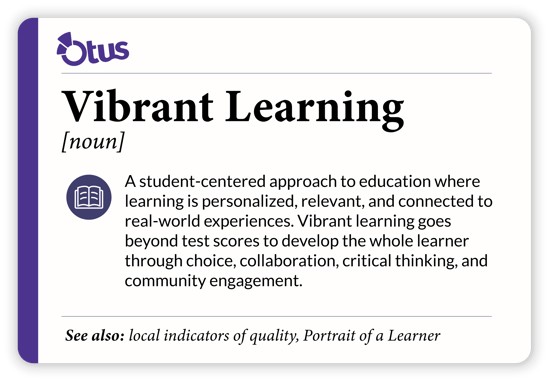 Another important part of HB 257 is the introduction of locally developed indicators of quality. The law allows districts to create local accountability systems in collaboration with their communities, including indicators connected to vibrant learning experiences and local measures of performance.
This part of the legislation comes from the work of the Kentucky United We Learn Council, which brought together students, families, educators, community members, legislators, and other stakeholders to rethink what assessment and accountability could look like across the state.
That offers an incredible opportunity. Local indicators give districts a way to measure what their unique communities value, such as student agency, career readiness, communication, collaboration, or even Portrait of a Learner competencies.
Of course, a shift of this caliber requires implementation, and with that comes plenty of questions.
What evidence will your district collect? How will you make the data digestible to families and community members? How will you ensure measures are meaningful across schools? How will your team break down results by different student groups and explain what it means clearly?
HB 257 encourages districts to work more closely with their communities, and that can foster an incredible learning environment for students. But to do that well, leaders need a way to collect, organize, analyze, and share evidence of progress.
Less state testing time doesn’t mean less focus on writing
HB 257 reduces state testing time by removing on-demand writing and editing mechanics from state assessments. However, writing remains a clear priority. KDE is tasked with developing guidelines and professional learning to support standards-aligned writing programs across content areas. It’s also the district's responsibility to adopt and publish writing program policies.
So, while writing may no longer appear in the same way on state assessments, communication skills remain central to student success. Under HB 257, districts need to think about how writing is taught, practiced, supported, and measured across subject areas.
In practice, that could mean common rubrics, performance tasks, student portfolios, classroom-based assessments, or any other evidence that helps educators understand how students are developing as communicators.
This could also connect naturally to local indicators of quality. If a district values critical thinking or career readiness, writing evidence can help bring those priorities to life.
Targeted quality measures add another layer of visibility
HB 257 also adds targeted quality measures to the Kentucky School Report Card, including teacher credentials, eighth-grade credit attainment, FAFSA completion, and other indicators connected to student readiness. These measures will appear on the school and district report card through June of 2030, before becoming part of the statewide accountability system beginning July of 2030.
For district leaders, this is another reason to think carefully about whether their data systems are ready to navigate HB 257.
Accountability is expanding beyond traditional academic measures. Leaders will need reliable, connected ways to understand progress across multiple priorities and communicate clearly with stakeholders.
What Kentucky districts can do now
HB 257 is set to take effect before the start of the 2026-27 academic year, putting districts just months away from implementation.
The time to prepare is now. And a strong starting point is to look at the systems already in place.
Before the final bell rings this summer, school and district leaders should ask:
Can our team view local assessment results, state test metrics, attendance patterns, and intervention history together?
Can leaders see growth trends by student, school, subgroup, and program?
Can teachers instantly identify students who are missing class and struggling academically?
Can our district track evidence connected to local priorities?
Can families understand their child’s progress and contribute to their learning journey in a meaningful way?
These are the questions that will shape how prepared districts feel as HB 257 goes from legislation to daily practice.
How Otus supports Kentucky districts navigating HB 257
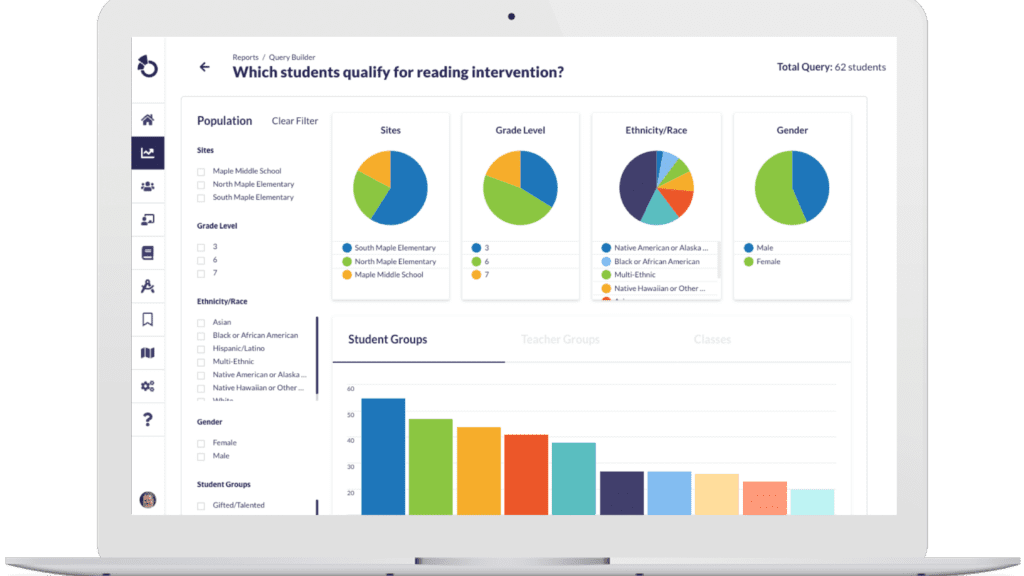
Otus brings assessment, attendance, intervention, and cognitive data together in one student profile, giving district and school teams the connected view HB 257 demands.
See individual growth clearly. Track each student's progress over time and view trends across schools, grade levels, student groups, or programs without piecing together multiple systems.
Connect attendance to the bigger picture. Link attendance patterns to academic performance and intervention history so your team can spot at-risk students and act early.
Collect evidence for local indicators. Organize the evidence your community values, from performance tasks and rubrics to Portrait of a Learner competencies, and use it to show what meaningful learning looks like in your schools.
Ask questions, get answers. Otus AI lets educators ask questions about their data in plain language and surface insights immediately, without spending hours digging through reports.
Kentucky districts are about to take on more data than ever before. What matters most is whether that data helps leaders make better decisions for students.
Related Resources
Request a demo!
See exactly how Otus can help your school accelerate student growth and improve student outcomes – all while saving educators time.