

Oct 30, 2026
Schools collect more student data than ever. Grades. Test scores. Attendance. Behavior notes. Yet many students still can't answer a simple question: How do I learn best? And that question matters. Once students can confidently answer it, they unlock stronger engagement, higher achievement, and more agency.
A learner profile can provide the answer to students. But only if it includes the right data. Here's what a learner profile is, why cognitive data belongs in it, and how it helps students take ownership of their growth.
What Is a Learner Profile?
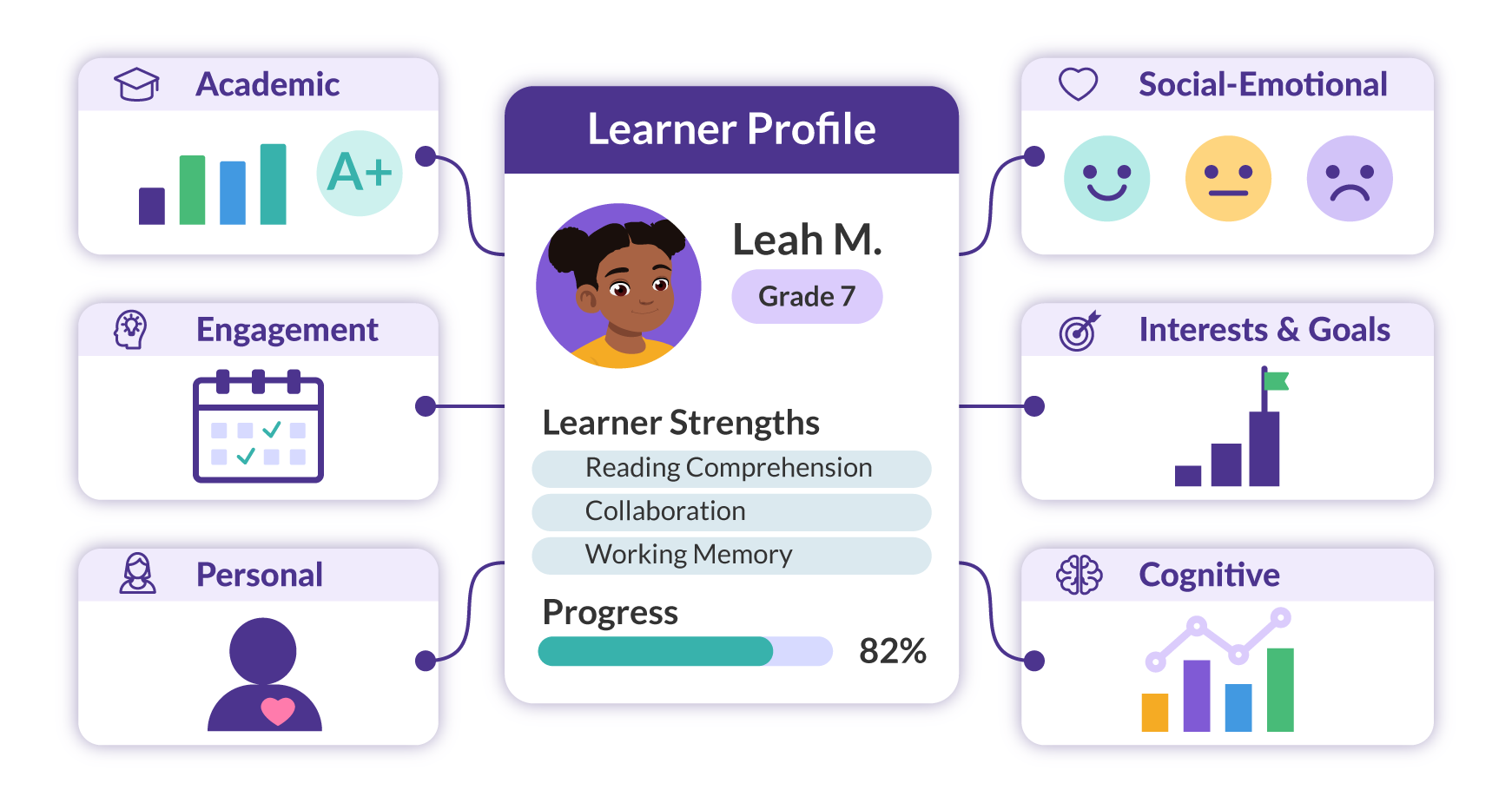
A learner profile is a living snapshot of the whole student, at present time. A complete learner profile brings together what a student knows, how they learn, and what drives them, all in one place.
Think of it as the opposite of a report card. A report card tells you what happened. A learner profile, informed and built by data, educators, and students, helps educators and students decide what to do next.
A strong learner profile is:
- Holistic. It reflects the full student, not just academic scores.
- Current. It updates as the student grows and evolves.
- Shared. Teachers, families, and students can all use it.
- Actionable. It points to specific next steps to support the student.
What Makes a Learner Profile a Powerful Tool for K-12 Education?
A complete learner profile is a powerful tool for both students and educators. When students see a complete picture of themselves in the school setting, it helps them build self-awareness, reflect on their growth, understand how they learn best, and take ownership of their educational goals. For educators, seeing a comprehensive picture of the whole child helps them guide personalized instruction, adapt their teaching methods to utilize strengths-based strategies for their students, and ultimately build more authentic relationships with their students.
A learner profile turns scattered data into a single, usable picture. That matters for three reasons.
- It saves teachers time. Instead of piecing together data from multiple systems, educators see the full picture in one view.
- It helps personalize instruction. When teachers know a student's strengths and challenges, they can adjust how they teach, not just what they teach.
- It builds a common language. Teachers, counselors, families, and students talk about the same strengths and goals.
A learner profile is a meaningful tool that can shift the conversation by focusing on the question "What does this student need to thrive?” instead of “What's wrong with this student?". And that’s powerful.
What Data Belongs in a Learner Profile?
For a Learner Profile to be as actionable and impactful as possible, it must be:
✔️ Simple.
✔️ Accessible.
✔️ Complete.
The best learner profiles pull from several data types. Each one answers a different question.
- Academic data. What does the student know? Grades, state assessments, benchmark results, and real work samples.
- Engagement data. Is the student showing up and participating? Attendance, behavior, and classroom participation.
- Personal data. What has shaped this student prior to now? Family, community, and cultural background information.
- Social-emotional data. How is the student feeling? Surveys, check-ins, and SEL screeners.
- Interests and goals. What motivates the student? Their own words, their own aspirations.
- Cognitive data. How does the student think and learn? Learning style and preferences; i.e., how they learn best.
What is Cognitive Data in a Learner Profile?
The Cognitive Data is the piece that most districts are missing, and is the most crucial data that will make a difference for students in owning their learning. Once students can see and understand how their mind works best to learn, they are more likely to take a more active role in their learning. The ongoing access to cognitive data makes self-knowledge more accurate and more actionable.
Academic data shows the result of learning. It doesn't explain the cause. That’s what the Cognitive data is for. Let’s examine why that matters:
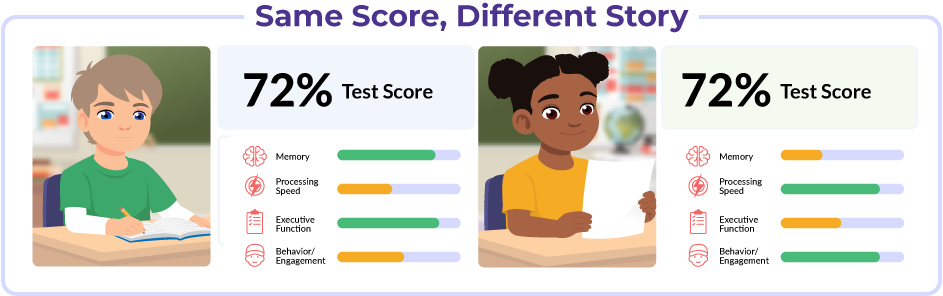
Two students can earn the same score for very different reasons.
One may struggle with working memory.
Another may have strong reasoning skills but need more time to process.
The score looks identical.
The support each student needs is not.
Cognitive data fills that gap. It measures the underlying skills that drive learning, such as memory, attention, reasoning, processing speed, and flexible thinking. With that insight, educators stop guessing why a student is stuck. They can see it and address it.
Cognitive data also does something else differently. It leads with strengths. Every student has them. When a learner profile explicitly names those strengths, students and teachers have something positive to build on.
How Do Learner Profiles Support Student Agency?
Student agency means students have a voice and a choice in their learning. With student agency, students set goals, make decisions, monitor progress, and know when to adjust when something isn’t working.
Developing student agency means students become active participants in their learning. Research shows that increased levels of student agency lead to high levels of engagement, persistence, academic growth, and college- and career-readiness.
Here’s the thing. Students can't own what they can't see or understand. A learner profile gives them the information they need to take charge and develop stronger student agency.
When students know their strengths, they can:
- Choose strategies that work. A student who knows they learn well visually can make that a habit.
- Ask for what they need. "I do better when I can talk it through" is a powerful sentence when students have what they need to advocate for themselves.
- Set meaningful goals. Goals based on real self-knowledge are goals students care about.
- Reframe struggle. Difficulty stops feeling like a personal failing and instead becomes a signal to try a different approach.
This is where cognitive data matters most. Self-awareness about how you learn is one of the most useful skills a student can build. It carries into every class, and into life beyond school.
How Do Students Interact with Their Own Learner Profiles?
A learner profile is most impactful when students actually use it. That means making it accessible, understandable, and part of everyday school life.
Here's what that looks like in practice:
- Viewing their own strengths. Students see a clear, age-appropriate view of how they learn, written in simple-to-understand language.
- Setting goals. Students pick goals that connect to their profile, then track progress over time.
- Reflecting. Short, regular check-ins help students notice what's working.
- Leading conversations. Students bring their profile to conferences and planning meetings during school and can share them with their families as well. Students no longer just sit and listen.
- Updating over time. Students add new interests, adjust goals, and share reflections as they grow.
When students lead conversations about their own learning, the dynamic changes. Adults stop being the only ones with answers. Students become partners who feel responsible for their plan and progress.
Are Most Learner Profiles Truly Complete Student Profiles?
Honestly? No.
Most learner profiles rely heavily on academic and attendance data. That's the data schools already have. It's easy to collect and easy to display, and has been for decades.
But it tells only part of the story. A profile built on test scores and grades shows where a student is. It can't show why, and it can't show what to do about it.
Here's a quick test. Look at your current learner profile and ask:
- Does it show how each student thinks and learns?
- Does it identify strengths, not just gaps?
- Can a student read it and learn something new about themselves?
- Does it suggest specific strategies teachers can use tomorrow?
If the answer to any of these is no, the profile is incomplete. To be as impactful as possible, the learner profile must answer “The Why” behind a student’s success at school. To answer that, including cognitive data is necessary.
Is There a Solution that Helps Build a Complete Learner Profile?
Building a complete learner profile takes two things: the right data, and one place to put it. Otus and MindPrint deliver both.
MindPrint provides the cognitive layer that most schools are missing. MindPrint’s assessment was developed by neuroscientists at the University of Pennsylvania and funded through five National Science Foundation grants. It gives every student a clear picture of their learning strengths, along with a personalized learning plan. It's shown to improve academic achievement in grades 3-12.
Otus brings all student data together in one platform. Educators get a single, complete view of each student. Students and families get visibility into progress and goals.
Together, they help schools:
- Build truly complete profiles. Academic, engagement, and cognitive data in one place.
- Turn data into action. Move from insight to strategy, fast.
- Make students active participants. Give them the tools to understand and own their learning.
- Lead with strengths. Start every conversation with what each student does well.
When schools combine what students know with how they learn, learner profiles become more than a record. They become a tool for growth that educators and students utilize.
Ready to build more complete learner profiles? Learn how Otus and MindPrint work together to help every student understand their strengths and take ownership of their learning.
Request a demo!
See exactly how Otus can help your school accelerate student growth and improve student outcomes – all while saving educators time.