

Jun 1, 2026
Standards-based grading isn’t inherently confusing, but it does come with a lengthy list of terms, definitions, and subtle distinctions that can make the approach feel more complicated than it needs to be.
Mastery. Proficiency. Standards. Rubrics. Scales. Learning targets.
Individually, these words are not complex. But once a school starts seriously rethinking how it grades and reports learning, it takes more than just recognizing the terminology. A “3” might mean a student is precisely where they need to be, while a family member sees it and wonders whether that translates to a C. If a student hears they’re “approaching proficiency,” they may assume they’re failing. A teacher might use “mastery” and “proficiency” interchangeably, while another sees them as two different levels of understanding.
That’s why shared language is so important. Standards-based grading only works when everyone involved understands what it is trying to communicate.
Consider this glossary your cheat sheet for understanding SBG. In it, we break down the most common terms and explain how they show up in real grading conversations, from instruction and assessment to feedback, progress monitoring, family communication, and student growth.
A benchmark is a specific point of reference used to measure student progress toward a standard or goal.
In standards-based grading, benchmarks help educators understand whether students are on track at a specific point in time. They can be tied to grade-level expectations, district pacing guides, assessment windows, or intervention goals.
For example, a third-grade reading team may use a benchmark to determine whether students are progressing toward grade-level fluency by the middle of the year. If students are not meeting that benchmark, teachers can adjust instruction or provide targeted support before the gap grows.
Benchmarks are especially useful when SBG is connected to MTSS because they help teams decide when a student needs additional support and whether that support is working.
Competency-based learning is an instructional approach where students move forward by demonstrating mastery of defined skills or competencies.
In a competency-based learning system, time is flexible, and learning is the constant. Students might progress at different rates depending on when they show they are ready for what comes next.
Standards-based grading and competency-based learning are closely connected, but they aren’t the same thing. SBG is primarily a grading and reporting practice. CBL is a broader learning model that often includes flexible pacing, performance tasks, reassessment, and student agency.
A school can use standards-based grading without fully adopting competency-based learning. However, SBG often creates a strong foundation for CBL because it gives educators clearer information about what students know and are ready to do next.
Evidence of learning is any student work, assessment, performance, or demonstration that helps show what a student knows and can do.
In standards-based grading, teachers use evidence to determine how well a student has mastered a specific standard or learning target. That evidence might come from a quiz, project, writing sample, lab report, presentation, performance task, classroom observation, or student conference.
The key is that the evidence must connect clearly to the standard being measured.
For example, if the standard asks students to support claims with textual evidence, a student’s score should be based on how well they do that skill, not whether they turned the assignment in early or contributed to a classroom discussion.
Strong SBG systems make evidence easier to interpret because the grade is tied to the learning itself.
A formative assessment is a check for understanding that helps teachers and students decide what needs to happen next.
Formative assessments are often low-stakes and happen throughout instruction. They might include exit tickets, quick writes, short quizzes, student responses, conferences, or practice problems.
In standards-based grading, formative assessments can provide valuable evidence of progress, especially when they show whether students are moving closer to proficiency on a specific skill.
A formative assessment does not need to become a final grade. Its purpose is to give students feedback and inform instruction before a larger assessment takes place.
A learning target is a student-friendly statement that describes what students are expected to learn or demonstrate.
Learning targets are usually smaller and more specific than academic standards. They help translate broad expectations into clearer daily goals.
For example, a standard might ask students to “analyze how an author develops a theme.” A learning target might say, “I can explain how a character’s actions help reveal the theme of the story.”
That smaller statement gives students a clearer understanding of what they are working toward. It also helps teachers align instruction, assessment, feedback, and grading.
In standards-based grading, learning targets make the grading process more transparent. Students know what success looks like, and teachers have a clearer way to assess progress toward the standard.
Mastery means a student has demonstrated a strong, consistent understanding of a skill or standard and can apply it successfully.
In standards-based grading, mastery is the end goal. It shows that a student has moved beyond early understanding and can use the skill with confidence.
Mastery does not usually mean perfection. A student can make minor errors and still demonstrate mastery if their work shows deep understanding and consistent success with the standard.
For example, a student may show mastery of a math standard if they can solve problems accurately, explain their reasoning, and apply the concept in a new situation. The teacher is looking for evidence that the student truly understands the skill, not just that they got one question right.
Mastery is also why reassessment is important in SBG. If a student does not master a skill the first time, they can keep learning and show new evidence later.
Mastery learning is an instructional approach where students continue working on a skill until they demonstrate understanding.
The core idea is simple: students learn at different speeds, and grades should reflect where they are now in their learning, not where they struggled earlier.
In a mastery learning model, students can receive additional practice, feedback, small-group instruction, or reassessment opportunities until they can show they understand the material.
Standards-based grading supports mastery learning because it reports progress by skill. Instead of averaging early mistakes with later success, SBG allows more recent evidence to carry greater meaning.
The thought behind this is that learning is supposed to grow. A student who struggled with multiplying fractions in November but demonstrates a strong understanding in December should have a grade that reflects the current level of learning.
A performance task asks students to apply knowledge or skills in a meaningful, often more complex context.
Performance tasks are commonly used in standards-based grading and competency-based learning because they show whether students can use what they have learned.
A performance task might ask students to write an argument, design an experiment, present a solution, analyze data, create a model, or complete a project connected to real-world application.
In SBG, performance tasks can provide strong evidence of mastery when they are aligned to clear standards and scored with a rubric. They are especially useful when teachers want to see how students transfer skills into new situations.
A priority standard is a standard that a school or district identifies as especially important for grade-level success.
Teachers cannot assess every standard with the same depth at all times. Priority standards help teams focus on the skills that matter most for long-term learning.
In standards-based grading, priority standards often become the foundation for reporting, common assessments, intervention planning, and PLC conversations.
For example, a district might identify certain reading comprehension or math standards as priority standards because they are essential for future coursework. Teachers can then design assessments and grading practices around those shared expectations.
Priority standards also help make SBG more manageable. Instead of trying to report on everything, schools can focus on the standards that provide the clearest picture of student progress.
Proficiency means a student has met the expected level of performance for a standard or learning target.
In many standards-based grading systems, proficiency is the target students are working toward. It means the student can demonstrate the skill at the level expected for their grade or course.
Proficiency and mastery are related, but they aren’t always identical. Proficiency often means the student has met the standard. Mastery usually suggests a deeper, more consistent understanding.
For example, a student may be proficient if they can solve grade-level equations correctly. They may show mastery if they can solve them, explain their reasoning, apply the skill in word problems, and avoid common misconceptions across multiple tasks.
Schools need to define these terms clearly before implementing SBG. When everyone in a school community understands the difference between proficiency and mastery, grades become much easier to interpret.
Progress monitoring is the ongoing process of tracking how students are growing on specific skills or goals over time.
In standards-based grading, progress monitoring helps teachers see whether students are moving closer to proficiency or mastery on a standard.
This is especially important for students receiving intervention. Instead of waiting for a report card or final assessment, teachers can look at current evidence and ask, “Is the support working and the student improving, or does the plan need to change?”
SBG makes progress monitoring more useful because it separates skills. A student might be improving in one area while still needing support in another. That level of detail helps teachers respond more precisely.
Reassessment gives students another opportunity to demonstrate learning after receiving feedback, support, or additional practice.
Reassessment is a major part of most standards-based grading systems because SBG focuses on current understanding.
In a traditional grading system, a low score early in a unit may continue to drag down a student’s average, even after they learn the material. In SBG, the goal is to capture what the student knows now.
That doesn’t mean students can retake anything at any time with no structure. Strong reassessment practices include clear expectations. Students might need to complete corrections, practice, conferencing, or additional learning before they reassess.
A rubric is a scoring guide that describes different levels of performance for a skill, standard, or task.
In standards-based grading, rubrics help teachers score student work consistently and explain what progress looks like.
A strong rubric goes beyond assigning points, describing the qualities of student work at each level. A writing rubric might explain what it means to be beginning, approaching proficiency, proficient, or advanced in using evidence.
Rubrics are especially helpful because they make feedback clearer. Instead of telling a student they earned a 2 out of 4, a teacher can point to the specific description and explain what the student needs to do next.
For families, rubrics can also make SBG easier to understand, as they show what the score means and why the student received it.
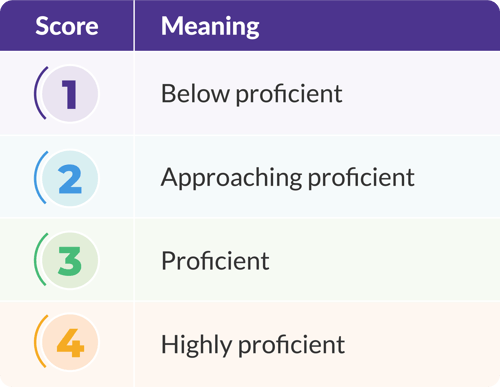
An SBG scale is the system used to describe a student’s level of performance on a standard.
Most schools use a 1–4 scale, though the exact labels and meanings can vary by district.
A common SBG scale might look like:
One of the most common questions families ask is, “What does a 3 mean?”
In many SBG systems, a 3 simply means the student is proficient. They are meeting the standard at the expected level. A 3 is not a B, or “average.” It’s often the goal.
It’s important for families to understand that. If they’re familiar with traditional grades, they might assume the highest number is the only successful or good score, but that’s not the case in SBG.
Schools need to define each score clearly and communicate those definitions often.
A scale score is a number that represents a student’s performance level based on a specific scoring scale.
In standards-based grading, a scale score is often used to show how well a student is performing on a standard. Usually, a student will receive a 2, 3, or 4 on a specific learning target based on the district’s unique SBG scale.
A scale score is different from a percentage. A 3 out of 4 doesn’t mean 75% or a C. It usually means a student is proficient.
This is, understandably, one of the biggest shifts for students and families. In traditional grading, numbers are treated as percentages, whereas in SBG, they represent levels of understanding.
That means schools need to explain scale scores carefully. Without clear communication, families might misinterpret a score that shows solid progress.
Standards are the specific skills, concepts, or knowledge students are expected to learn at a certain grade level or in a specific course.
In standards-based grading, standards are the foundation of the gradebook.
Instead of reporting one overall grade for a class—be it English, math, science, social studies, or another— SBG reports how a student is performing on specific standards within that subject.
For example, a traditional English grade could show that a student has an 87%. A standards-based report might instead show that the student is proficient in identifying themes, approaching proficiency in citing evidence, and still developing in writing organized arguments. That gives teachers, students, and families a more useful picture of learning.
Standards help answer the question, “What exactly does this student know, and what do they still need to learn?”
A standards-based assessment is an assessment designed to measure student performance on specific standards or learning targets.
In standards-based grading, assessments need to align clearly with the standards being reported. If the gradebook is organized by standard, the assessment should provide evidence for those standards.
For example, a science test might include questions tied to several different standards. Instead of giving one overall test score, a teacher can record performance separately tied to each standard.
That makes the results much more useful. A student might understand one concept and need support with another. A single percentage would likely fail to reveal that, while a standards-based assessment brings it into focus.
Standards-based grading is a grading approach that reports student progress based on specific learning standards rather than one overall average.
Instead of combining tests, homework, participation, behavior, extra credit, and late penalties, SBG separates academic mastery by skill.
That’s what makes SBG so useful. Teachers can see exactly where students are strong and where they need more support, while students can understand what they need to work on next. Even families get a clearer view of learning than a traditional learning grade usually provides.
For example, instead of seeing a B in social studies, a family might see that their child is proficient in multiplication and beginning to understand fractions. That information is much easier to understand and act on.
A summative assessment measures what students have learned at the end of a unit, course, or learning period.
In standards-based grading, summative assessments often provide important evidence of proficiency or mastery. They may include unit tests, final projects, essays, presentations, performance tasks, or end-of-course assessments.
The difference is how the results are reported.
In a traditional grading system, a summative assessment likely produces one overall score. In an SBG system, the same assessment most likely provides separate scores for each standard being measured.
Teachers can see which standards students have mastered and which need reteaching, reassessment, or intervention. And that makes the assessment much more useful for instruction.
Traditional grading is a grading approach that typically combines multiple factors into one overall grade, often reported as a letter or percentage.
A traditional grade often includes everything from assessment results and homework completion to behavior and extra credit. The challenge is that one grade can make it hard to truly understand what a student knows.
One student might earn a C because they understand the content but frequently turn in work late. Another student might earn a B because they complete every assignment but still have gaps in key skills.
Standards-based grading gives schools a clearer way to separate academic mastery from habits and behaviors. That clarity can lead to better instruction and more useful conversations with families.
In a standards-based system, language matters
Even the best planned grading shifts can fall apart when people use the same words to communicate different things.
One teacher might define proficiency as “good enough,” while another teacher sees it as the expected target. From there, students and families only get more and more confused and frustrated.
But when schools define these terms well, grades become easier to understand and easier to act on. Teachers can better respond to specific needs, students can see a clear path forward, and families can better support learning at home.
Standards-based grading absolutely shines when everyone understands what the grade is trying to say.
How Otus supports clearer standards-based grading
SBG depends on clear evidence, consistent scoring, and shared language that the entire school community can understand.
Otus brings that work together in one place. Educators can create standards-aligned assessments, score student work with rubrics, track progress by standard, and view performance trends across classrooms, grade levels, and student groups.
That means teachers spend less time piecing together information from different systems and more time deciding what students need next. Leaders can see where students are making progress, where support is needed, and how grading practices are taking shape across the district.
With Otus AI, educators can also ask questions about their data in plain language and surface patterns instantly, meaning teams can move from standards-based evidence to next steps faster and more confidently.
Request a demo!
See exactly how Otus can help your school accelerate student growth and improve student outcomes – all while saving educators time.