

Aug 12, 2026
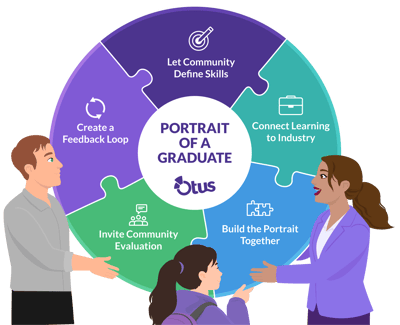 A Portrait of a Graduate is only as strong as the community behind it. When local employers, families, and partners help define what success looks like (and stay involved as students work toward it), the framework goes from a dusty document to a shared, living commitment.
During a recent webinar, leaders from Carroll County Public Schools (KY), joined by National Strategic Academic Advisor Dr. Terra Greenwell, shared how they’ve built that connection. Here are five ways they’re making it real.
Let community needs define the skills
Carroll County started their Portrait work the same way good community partnerships always start: by listening. Before a framework was built or a committee was formed, local employers and community members were already shaping what the work would become – and they were clear about what students were missing.
As Jeannie Rohrer, Supervisor of Instruction at Carroll County Schools, explained: “[The] community was consistently saying that students did not have a lot of the soft skills that they were looking for and that they needed to be successful.”
That feedback directly influenced the shift from compliance exercise to something that shapes learning in a meaningful way; something they call the “Panther Path.”
Embed work-based learning with local industry
Of course, gathering community input was just the beginning. Carroll County built ongoing partnerships that put students in real-world settings where those Portrait competencies are tested.
“We began to dig deeply, first of all, into our work-based learning programs at the high school, collaborating with our local business and industry. A lot of times it's so tied to academics, but we wanted to make sure we were addressing our community needs.”
Jeannie Rohrer
Supervisor of Instruction
,
Carroll County Schools (KY)
Portrait work becomes more meaningful when students go beyond classroom simulations of collaboration and apply it in a local business alongside adults with real expectations. That connection makes the competencies feel less abstract and more like the foundation they’re meant to be.
Involve community stakeholders in defining the Portrait
Carroll County’s goal wasn’t to hand off a finished product for their partners to rubber-stamp. From the beginning, the district’s Portrait design process included the full community—teachers, district leaders, and post-secondary partners all at the same table.
“We knew that we wanted to redefine what the diploma of a graduating Carroll County student meant,” Rohrer said. “Working with our workforce, our post-secondary people, and our teachers, a lot of common themes started to unfold. That’s how we were able to figure out what the skills we wanted to see within our students.”
Federal Grant Coordinator Amanda New added: “I think the biggest piece is making sure that we continually keep our district leaders, our school leaders, and community perspectives throughout all conversations, so that it doesn't become a person or from the district; it has ownership, not just for our staff, but for our students.”
When the community co-owns the Portrait, it becomes not only something they recognize but also a commitment they hold schools accountable for.
Bring community members into student demonstrations of learning
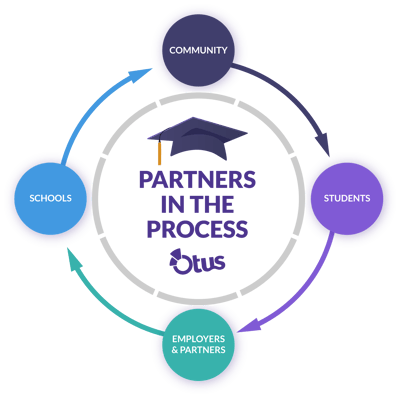 Carroll County didn’t stop at involving the community in the building of the Portrait. They invited community members to help evaluate it.
“We also wanted to measure the presentation of the capstone, because we want that to be the outside perspective of our community. And within our community, how are students doing with those durable skills, and providing that evidence and letting them see the bigger snapshot, knowing that the teachers can see that from the curriculum level, and then our partners outside can see that from the community level.”
When students present a capstone defense to real community members and not just teachers, the stakes shift. The work feels authentic. The skills matter more. Ultimately, the Portrait becomes something students can point to and say: "This is exactly what I’ve learned to do."
Use community voice as an ongoing feedback loop
Perhaps most importantly, Carroll County, throughout their process, kept going back to the community.
“One of the pieces that we keep going back to is to ensure that our community is tapped in and they're providing feedback to us. And also making sure that all of our schools are on the same page and that it's not something that we reference but that we live by within our schools and classrooms.”
Dr. Greenwell echoed the importance of this approach for any district trying to scale Portrait work:
“Great districts have 3–5 goals and no more than that. They stay very focused on them. From an academic lens, the only language you can speak has to be about those goals, and everything has to come back to those. So if Portrait of a Learner is truly a priority, then in every department, top down, no matter where it is, there has to be consistency of messaging. These are our expectations. This is the language we use. This is what we expect to see in every single classroom.”
Dr. Terra Greenwell
Strategic Advisor
,
Academic Consultant
Put simply, Portrait work requires a feedback loop; one that keeps the framework connected to evolving community expectations.
The takeaway for districts investing in Portrait work
Community connection is what brings a Portrait to life and keeps it alive over the long term.
Districts that keep stakeholders invested—in defining competencies, in designing learning experiences, in evaluating student growth, and in ongoing feedback—build Portraits that outlast any single initiative or school year.
As Rohrer put it, “It is the thing.”
Want to see how Carroll County made it happen? Watch the full webinar recording.
Request a demo!
See exactly how Otus can help your school accelerate student growth and improve student outcomes – all while saving educators time.