

Sep 22, 2026
Consider the math: a school day runs about six hours. Over a five-day week, that’s roughly 30 hours with a student, out of 168 hours in a week. That leaves well over 80% of a child’s time in the hands of family, home, and everywhere else life happens.
But when a student starts to struggle, the instinct in most schools is to look inward. What does the data say? What intervention tier fits? What are our next steps?
Those are the right questions. Yet there’s one conversation that often happens too late, or not at all: the one with the family.
We have about 50 years of research telling us that family engagement is one of the strongest predictors of student success. Not a box to check or something to pencil in around parent-teacher conference season. A genuine driver of outcomes, from attendance and behavior to academic performance and long-term trajectory. Dr. Karen Mapp at Harvard has spent her career making this case, connecting family engagement to faster literacy gains, higher attendance, lower dropout rates, and greater post-secondary enrollment.
And yet, in many schools, families are still treated as recipients of information rather than partners in the work. It’s a gap worth closing. For many students, the most powerful lever a school can pull is the one that connects the classroom to the living room.
What the research has been telling us
The evidence here is pretty striking once you start looking at it.
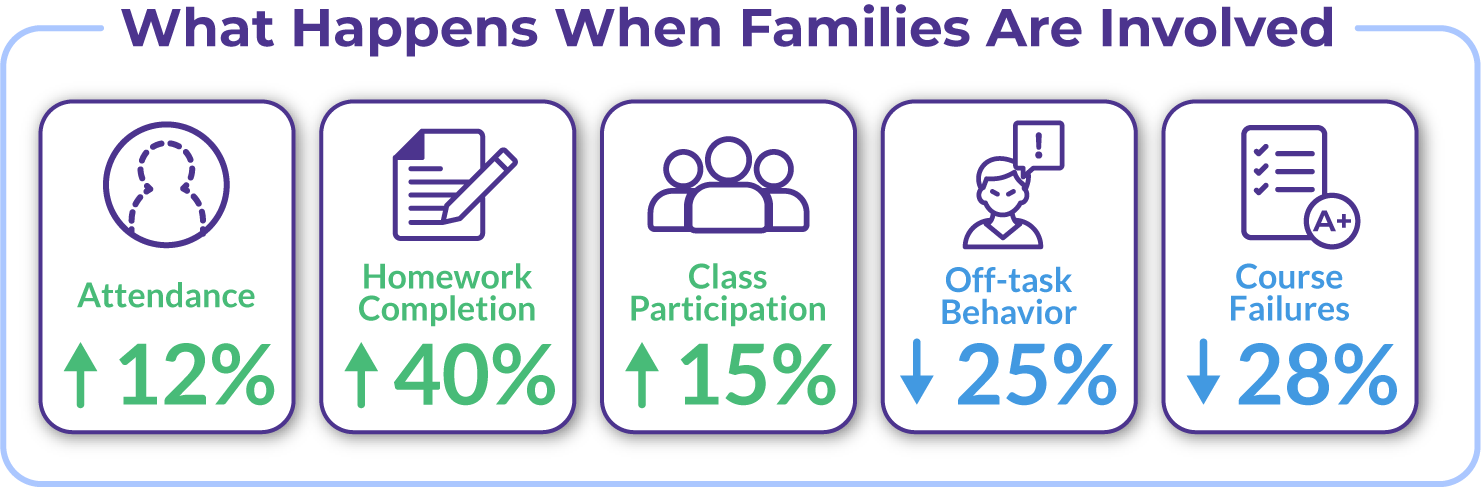
A randomized controlled trial found that simply texting parents weekly about their middle and high schoolers’ missed assignments, grades, and absences reduced course failures by a whopping 28% and increased attendance by 12%. The biggest gains went to students who were already struggling. Not a new curriculum. Not a new hire. The intervention was simply better communication.
There’s also research showing that when teachers reach out to families directly, students complete homework at a 40% higher rate, are 25% less likely to be off-task, and participate in class 15% more. Again, not a program, but a relationship.
Put plainly, when families are involved, students achieve more regardless of socioeconomic status, racial or ethnic background, or the parents’ own education level. They show up to class prepared and with a positive attitude, and carry that through until graduation.
Why engagement breaks down
So if the evidence is clear, why is meaningful family engagement still so hard to sustain?
A big part of the answer is that most school communication is built for transmission, not conversation. The newsletter goes out, the portal gets updated, and a report card arrives. Families receive information, but rarely feel like their perspective is valued or that their involvement would change anything.
The numbers from the most recent National Household Education Surveys drive this home. During the 2022-23 school year, 90% of K–12 families received schoolwide newsletters or general notices. But only 66% received something specifically about their own child, and just 41% got a phone call. Mass communication is nearly universal. Personal outreach, not so much.
A newsletter does a fantastic job of keeping the school community informed. But families feel known when someone reaches out about their specific kid, with something specific to say.
There’s also a trust piece that’s easy to overlook. For some families (especially those who had difficult experiences with school themselves), the invitation to engage doesn’t always feel genuine. Trust has to be built before engagement can flourish. The schools making the most progress here have likely stopped asking “how do we get families to show up?” and started asking “how do we make families feel like they belong?”
And those are profoundly different questions.
Engagement as intervention
Here’s what shifts when family engagement becomes a real priority: schools stop waiting for a student to hit a threshold before picking up the phone.
In most intervention models, families hear from the school when something has gone wrong. If attendance slips or grades drop, the call becomes part of the crisis response rather than part of a relationship that might have prevented the crisis in the first place.
 Proactive engagement flips that. When families receive consistent, meaningful communication about what their child is learning and where they’re growing (or where they’re thriving, even), they’re also far more receptive when something does go sideways. The relationship is already there, and the trust is already built. You’re not starting from zero.
It’s also worth looking at when engagement tends to drop off. Research shows family involvement in school starts to decline at the middle school transition, which is precisely when academic expectations start to increase. It’s a time when the stakes of disengagement are highest. Districts that treat middle school as a moment requiring more intentional outreach, rather than less, are better positioned to keep families in the conversation through the years that matter most.
When teachers already have a relationship with a student’s family, hard conversations tend to get easier. Families are more likely to share context that schools would never otherwise have. That student who seems checked out lately? It turns out they’re dealing with the loss of a loved one. That family that looks disengaged? They just lost their primary source of income. Members of the school community might be navigating barriers nobody ever thought to ask about.
That context changes what interventions look like and, more importantly, whether they work.
What meaningful engagement looks like in practice
Meaningful family engagement comes down to quality, consistency, and reciprocity.
Schools that do this well likely share a few things in common. They make communication personal. Rather than leaning entirely on mass messages, teachers and staff reach out directly to families with specific observations about their child. A quick note saying, “Alicia contributed something really thoughtful in class today. She shared…” does more for a family than a dozen automated reminders.
They make it two-way. Surveys and genuine listening sessions give families a channel to share what they’re seeing at home and what they hope for their child. That input shapes how schools respond, and families can see that it does.
And they work to remove barriers. Translation services, flexible meeting times, home visits, communication through channels families already use; these are signals that the school is serious about the relationship. Research from Dr. Mapp’s work found that when schools conduct home visits, students show a 20% decline in absences and are more likely to read at or above grade level than peers who didn’t receive them.
The families schools miss most
Here’s something worth sitting with: the families most likely to be left out of engagement are often the families whose students have the most to gain from being included.
The NCES data makes this clear as day. Parents of students below the poverty threshold reported participating in an average of five school activities during the year, compared to six for the families above it. Most importantly, the gaps were largest in volunteering and serving on school committees—the forms of involvement that tend to build the deepest relationships with schools. And overall, only 55% of parents reported being “very satisfied” with how school staff interact with them. Nearly half of families don’t feel that relationship is working well.
Low-income families, families whose primary language isn’t English, and families with limited schedule flexibility are all less likely to be drawn in by traditional engagement strategies. And those are the families who can least afford to be left out.
Equity-focused engagement means designing outreach that truly reaches every family. It means asking, for every strategy and every channel: who is this for, and who does it leave out?
It all starts with relationships
When family engagement works, it usually means it has moved out of the “programs and events” category and into the very fabric of how a school operates. It becomes the culture.
But like any worthwhile pursuit in life, it doesn’t happen overnight. It happens when leaders consistently treat families as partners. When teachers are equipped with the time and tools to reach out proactively. When data systems make it easy to share something meaningful about an individual student (not just flags and alerts). When every family interaction, even a hard one, is treated as an investment in a long-term relationship.
The districts seeing the biggest gains are the ones that have stopped treating the hours outside school as beyond their reach.
For many students, family engagement is where school improvement has to start.
Request a demo!
See exactly how Otus can help your school accelerate student growth and improve student outcomes – all while saving educators time.